
TL;DR:
- ADHD Awareness Month is a global event in October that aims to share science-based information and reduce stigma. It involves advocacy, education, community events, and policy efforts to support those affected by ADHD worldwide. Public campaigns combat myths and promote understanding to improve diagnosis, treatment, and acceptance across all age groups.
ADHD Awareness Month is a globally observed event every october dedicated to sharing reliable, science-based information about attention-deficit/hyperactivity disorder and reducing the stigma that prevents millions from seeking help. Led by a coalition that includes CHADD, ADDA, and the ADHD Coaches Organization, the month brings together advocates, clinicians, educators, and families around a shared goal: making sure accurate information reaches the people who need it most. If you have ever wondered what is ADHD awareness month and why it draws such broad participation, the answer starts with scale. Over 67 million people under age 20 were living with ADHD globally as of 2021. That number alone explains why one month of focused attention is not enough, but it is a powerful start.
What is ADHD Awareness Month and how did it begin?
ADHD Awareness Month traces its roots to the early 2000s, when several leading mental health organizations recognized that public understanding of ADHD lagged far behind the clinical research. Misinformation was widespread. Parents were blamed for their children's behavior. Adults with ADHD were dismissed as disorganized or lazy. A coordinated response was needed.
The ADHD Awareness Month coalition formed to fill that gap. CHADD (Children and Adults with Attention-Deficit/Hyperactivity Disorder), ADDA (Attention Deficit Disorder Association), and the ADHD Coaches Organization joined forces to produce and distribute science-based ADHD information each october. Over time, other advocacy groups, clinicians, and community organizations joined the effort, expanding its reach from a domestic campaign into a global platform.
The coalition's annual work includes several distinct pillars:
- Public education campaigns that distribute fact sheets, videos, and toolkits to schools, workplaces, and healthcare providers
- Community events ranging from local support group meetups to large online conferences and webinars
- Fundraising drives that sustain year-round programs, because awareness cannot stop on november 1st
- Social media campaigns that amplify personal stories and connect isolated individuals with support networks
- Advocacy efforts aimed at policy changes that improve access to diagnosis and treatment
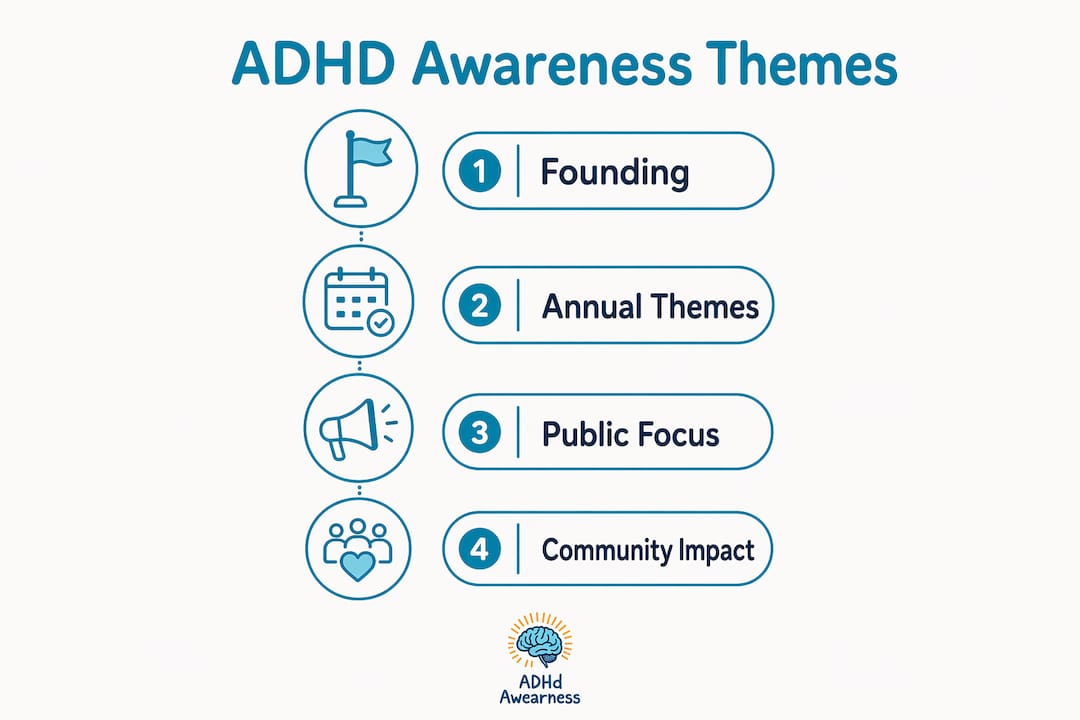
Each year, the coalition selects a theme to focus public conversation. Past themes have addressed ADHD across the lifespan, the unique experiences of women and girls, and the intersection of ADHD with mental health. That thematic structure keeps the month fresh and ensures different communities feel seen.
Why do ADHD awareness campaigns matter for public health?
ADHD is not a childhood phase. It is a neurodevelopmental disorder characterized by persistent inattention and/or hyperactivity-impulsivity, and its effects extend across a person's entire life. Approximately 10% of the global population is estimated to have ADHD. That figure means awareness campaigns are not niche advocacy. They address a condition affecting hundreds of millions of people worldwide.

The public health stakes go beyond behavior and productivity. Untreated ADHD links to increased cardiovascular risk and premature mortality. That connection reframes ADHD from a classroom management problem into a serious, lifelong medical concern that deserves the same public attention as diabetes or hypertension.
The economic burden is equally significant. A study examining ADHD's socioeconomic impact found that the cost per adult with ADHD runs into the millions of yen annually in Japan, driven primarily by productivity loss. The pattern holds across other economies too. When people go undiagnosed or untreated, they lose jobs, struggle in school, and cycle through healthcare systems without getting the right support.
"Raising ADHD awareness reframes the condition from personal failure to a legitimate medical condition requiring community support and proper treatment." — ADHD Awareness Month coalition
Stigma sits at the center of this problem. Fear of stigma causes people to delay seeking diagnosis or avoid treatment entirely. Awareness campaigns directly attack that fear by replacing shame with facts. When a parent hears a credible explanation of how ADHD affects executive function, they stop blaming their child and start seeking help. That shift in understanding is where public health outcomes actually improve.
How can you engage with ADHD Awareness Month effectively?
Participation does not require a platform or a budget. The most effective engagement often starts with a single conversation. Sharing your personal story, or the story of someone you love, puts a human face on a condition that statistics alone cannot convey. Coalition partners provide educational toolkits specifically designed for individuals, families, and caregivers who want to spread accurate information without needing clinical expertise.
Here are four concrete ways to get involved:
- Share personal stories and art. Written accounts, illustrations, and videos that reflect real ADHD experiences reach people who tune out clinical language. Platforms like Instagram, TikTok, and YouTube amplify these stories quickly.
- Use coalition resources. CHADD, ADDA, and the ADHD Coaches Organization publish free toolkits, webinars, and fact sheets every october. Download them, share them, and use them in conversations with teachers, employers, or family members.
- Attend or organize community events. Free community initiatives launched during october connect isolated or undiagnosed individuals with support networks. Local libraries, community centers, and online platforms all work as venues.
- Support advocacy financially. Donations during october amplify educational tools and sustain year-round programs. Even small contributions to coalition organizations extend the month's impact into the other eleven months of the year.
Pro Tip: If you want to organize a local event, start with a single goal. A one-hour panel discussion at a school or workplace is more effective than a sprawling event with no clear focus. Invite one clinician, one person with lived ADHD experience, and one educator or employer. That combination covers the three audiences who most need to hear each other.
You can also learn how to communicate about ADHD more effectively, which makes every conversation during the month more productive.
What are the most common ADHD myths that awareness campaigns debunk?
Misinformation about ADHD is not just frustrating. It delays diagnosis, blocks access to treatment, and causes real harm. Awareness Month campaigns dedicate significant effort to correcting the myths that persist despite decades of research.
The most damaging misconceptions include:
- "ADHD is not a real disorder." ADHD is recognized by the American Psychiatric Association, the World Health Organization, and every major medical body worldwide. The DSM-5 criteria provide a clear diagnostic framework, and neuroimaging research shows measurable differences in brain structure and function.
- "Only hyperactive boys have ADHD." Girls and women are frequently missed because they often present as quietly inattentive rather than disruptive. Adults are also routinely overlooked, particularly those who developed coping strategies that mask symptoms.
- "ADHD is caused by bad parenting or too much screen time." Genetics account for the majority of ADHD risk. Environmental factors play a role, but parenting style is not the cause.
- "People with ADHD just need to try harder." ADHD affects executive function, the brain's ability to plan, prioritize, and regulate attention. Telling someone with ADHD to try harder is like telling someone with poor vision to look more carefully.
When these myths go unchallenged, people avoid seeking diagnosis. Awareness Month creates a concentrated window of public attention where corrections reach the widest possible audience. Correcting one myth in a workplace training session or a school newsletter can change how a teacher responds to a struggling student for years.
How do ADHD Awareness Month initiatives support educators and employers?
Educators and employers are two of the most important audiences for ADHD awareness, and also two of the most underserved. Many teachers receive little or no formal training on ADHD during their certification programs. Many managers have never encountered evidence-based guidance on workplace accommodations. The result is that people with ADHD face environments that work against them, not because of malice, but because of ignorance.
Specialized training for educators and employers is a central goal of Awareness Month. Coalition partners publish resources specifically designed for these groups, covering topics from classroom accommodations to flexible work arrangements.
| Stakeholder | Common challenge | Awareness Month resource |
|---|---|---|
| Teachers | Misreading inattention as defiance | ADHD classroom guides and webinars |
| School counselors | Lack of referral pathways | Coalition toolkits with diagnostic resources |
| Employers | No framework for accommodations | Workplace inclusion fact sheets |
| HR professionals | Uncertainty about legal obligations | Evidence-based accommodation guides |
| Caregivers | Isolation and burnout | Support group directories and online communities |
Understanding ADHD and working memory is particularly useful for teachers, because working memory deficits explain many of the classroom behaviors that get misread as laziness or disrespect.
Pro Tip: Employers who implement even basic ADHD accommodations, like written instructions, flexible deadlines, and quiet workspaces, often see improvements in productivity and retention that extend well beyond employees with ADHD. Good design for neurodivergent people tends to be good design for everyone.
The long-term impact of this training is measurable. When educators recognize ADHD early and respond with support rather than punishment, students stay in school longer and perform better. When employers create inclusive environments, workers with ADHD contribute at their full capacity instead of burning out and leaving.
Why I believe ADHD Awareness Month is more than a calendar event
I have watched awareness campaigns evolve over many years, and the most important shift I have seen is not in the volume of information shared. It is in who feels safe enough to come forward. A decade ago, adults with ADHD routinely described their diagnosis as something to hide. Today, more people share their experiences openly, and that change traces directly to sustained, coalition-driven awareness work.
The collaboration between CHADD, ADDA, and the ADHD Coaches Organization matters more than any single campaign. No one organization can reach every community, every language, or every professional sector. The coalition model distributes that responsibility and multiplies the impact. When I see a teacher in a rural school district using a coalition toolkit, or an HR manager citing ADHD research in a policy meeting, I recognize the downstream effect of years of coordinated advocacy.
What concerns me is passive observation. Reading an article about ADHD Awareness Month and feeling informed is not the same as doing something. The people who most need to hear this information are not searching for it. They are the parent who thinks their child is just difficult, the adult who has been fired three times and does not know why, the employee who cannot get through a meeting without losing focus. Reaching them requires active participation from people who already understand. You can start by supporting adults with ADHD in your own circle, not just during october, but every month.
Awareness changes lives when it moves from information to acceptance, and from acceptance to action.
— Jason
ADHD Awearness: supporting the cause every day
ADHD Awearness was built on the belief that awareness should not stop when october ends. The platform combines educational content, including blogs, videos, and podcasts, with 100% USA-made apparel that carries the conversation into everyday life.
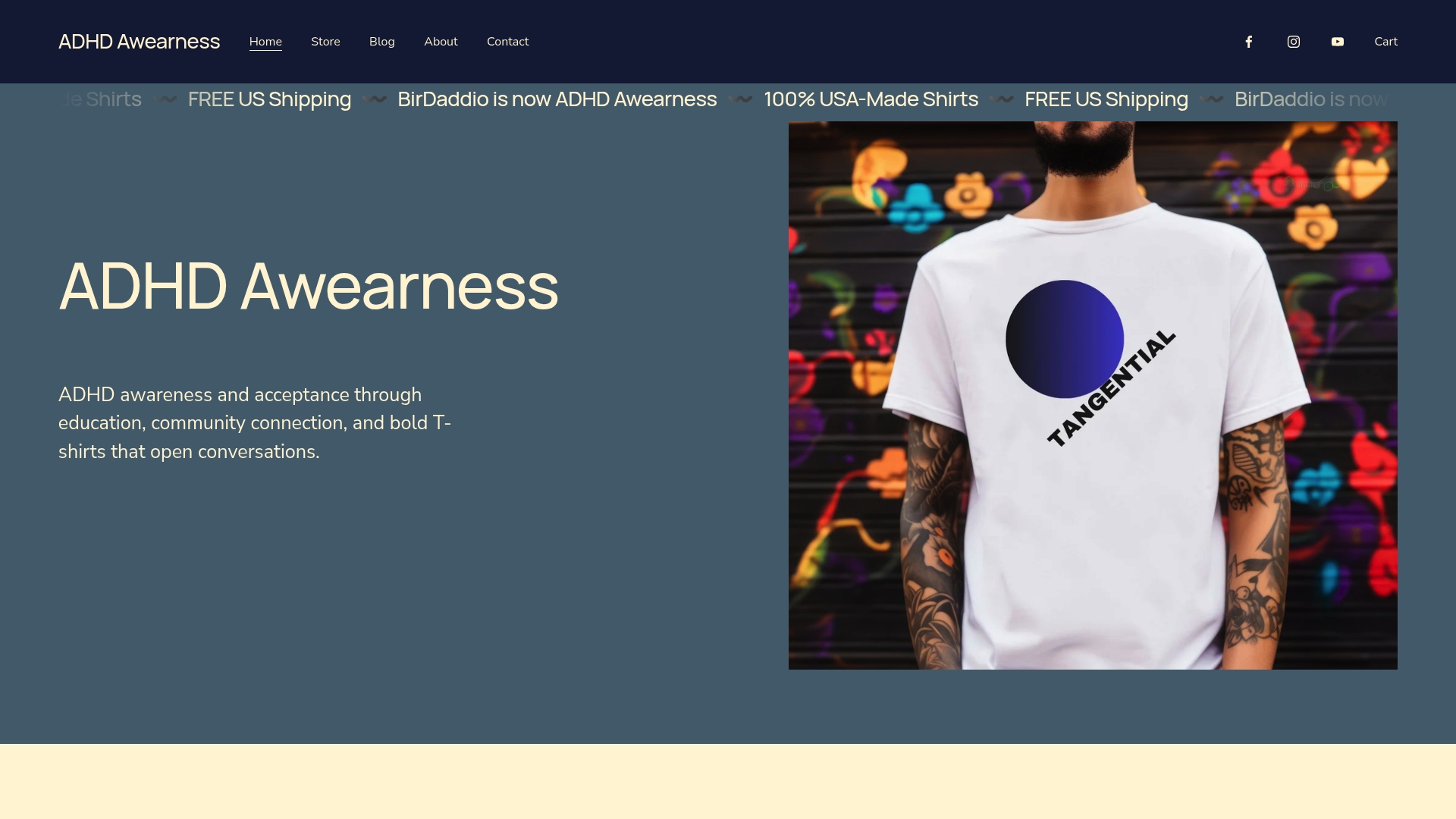
Every purchase from the ADHD Awearness store supports ADHD-focused nonprofits directly, with a portion of each sale going to organizations that fund research, education, and community support. The Abilities Collection is a strong starting point if you want apparel that reflects ADHD strengths rather than deficits. Wearing a message is one of the simplest ways to start a conversation with someone who needs to hear it. That conversation might be the one that finally gets someone the help they deserve.
FAQ
What month is ADHD Awareness Month?
ADHD Awareness Month is observed every october. The month is coordinated by a coalition that includes CHADD, ADDA, and the ADHD Coaches Organization.
Who organizes ADHD Awareness Month?
The ADHD Awareness Month coalition organizes the event. It brings together major advocacy organizations, clinicians, and community groups to share science-based information and reduce stigma.
Why does ADHD awareness matter for adults?
Untreated ADHD in adults links to increased cardiovascular risk and premature mortality, making awareness a public health priority that extends well beyond childhood diagnosis.
How can I participate in ADHD Awareness Month?
You can share personal stories, use free coalition toolkits, attend or organize community events, and support advocacy organizations financially. Even a single conversation with an educator or employer counts.
What is the biggest myth about ADHD that awareness campaigns address?
The most damaging myth is that ADHD is not a real disorder. Every major medical body worldwide, including the American Psychiatric Association and the World Health Organization, recognizes ADHD as a legitimate neurodevelopmental condition.