

TL;DR:
- ADHD is a disorder of attention regulation, not simply a short attention span.
- Understanding this shift helps in supporting children effectively and debunks common myths.
ADHD is defined by the CDC and WHO as a neurodevelopmental disorder of attention regulation, not simply a short attention span. That distinction matters enormously. The popular image of a child who cannot sit still or pay attention for more than a minute misses the real picture entirely. ADHD attention span myths debunked by current science reveal something far more nuanced: the ADHD brain struggles to regulate when and how it focuses, not whether it can focus at all. Understanding this difference changes how you support a child in your classroom or at home, and it starts with replacing myths with facts.
What does science actually say about ADHD and attention span?
ADHD is not a uniform attention deficit. Research published in Scientific Reports shows that individuals with ADHD linger longer on distractor stimuli before engaging with a goal-directed task. That finding reframes everything. The problem is not that the ADHD brain cannot pay attention. The problem is that it has difficulty shifting attention away from what is immediately engaging toward what is required.

This process is called inhibitory control, and it depends on goal-directed processing. In ADHD, that processing is delayed. Think of it like a browser with too many tabs open. The system is running, but switching to the right tab takes longer and costs more effort than it should. The result looks like inattention from the outside, but the internal experience is one of competing signals rather than silence.
| Attention stage | Typical processing | ADHD processing |
|---|---|---|
| Initial stimulus detection | Fast, automatic | Fast, automatic |
| Distractor engagement | Brief, easily released | Prolonged, harder to release |
| Goal-directed shift | Quick and efficient | Delayed, requires more effort |
| Sustained task focus | Stable with moderate interest | Variable, interest-dependent |
| Inhibitory control | Reliable | Frequently impaired |
The table above shows that ADHD does not impair every stage of attention equally. Detection works fine. The breakdown happens at the transition from distraction to goal. That is why a child with ADHD can notice every sound in the room and still miss the teacher's instructions.
Pro Tip: When reading ADHD research, check whether a study measures attention capacity or attention regulation. Those are different constructs, and conflating them produces misleading conclusions.
How does hyperfocus fit into the ADHD attention picture?
Hyperfocus is one of the most misunderstood traits in ADHD. Hyperfocus describes intense absorption in a stimulating task, sometimes lasting hours, to the exclusion of everything else. Parents often see a child who "cannot focus" in class but plays video games for three hours without blinking. Educators sometimes interpret this as proof that the child is choosing not to pay attention. Both conclusions are wrong.
Hyperfocus and distractibility come from the same source: attention dysregulation. The ADHD brain is not broken in one direction. It swings between states depending on how much dopamine-driven interest a task generates. Low-interest tasks produce distraction. High-interest tasks produce hyperfocus. Neither state is fully voluntary, which is why telling a child to "just focus" on a boring worksheet is as unhelpful as telling them to stop hyperfocusing on something they love.
Understanding hyperfocus also helps you recognize ADHD in children who look nothing like the stereotypical hyperactive boy. A girl who is quietly absorbed in drawing for hours while missing every verbal instruction is showing the same underlying regulation pattern. Her ADHD attention regulation looks different on the surface, but the neurological mechanism is identical.
Key characteristics of hyperfocus in ADHD:
- Intense, sustained engagement with high-interest tasks
- Difficulty stopping even when the task is complete or time has run out
- Reduced awareness of surroundings, hunger, or time passing
- Followed by difficulty transitioning back to lower-interest demands
- Not a sign of willful defiance or selective effort
Recognizing hyperfocus as a feature of ADHD rather than a contradiction helps parents and educators set realistic expectations and design better transitions between activities.
Common myths about ADHD attention span, debunked
The myths below cause real harm. They delay diagnosis, increase shame, and lead to support strategies that do not work. Each one has been directly addressed by researchers and clinicians including Dr. Russell Barkley, one of the world's leading ADHD researchers.
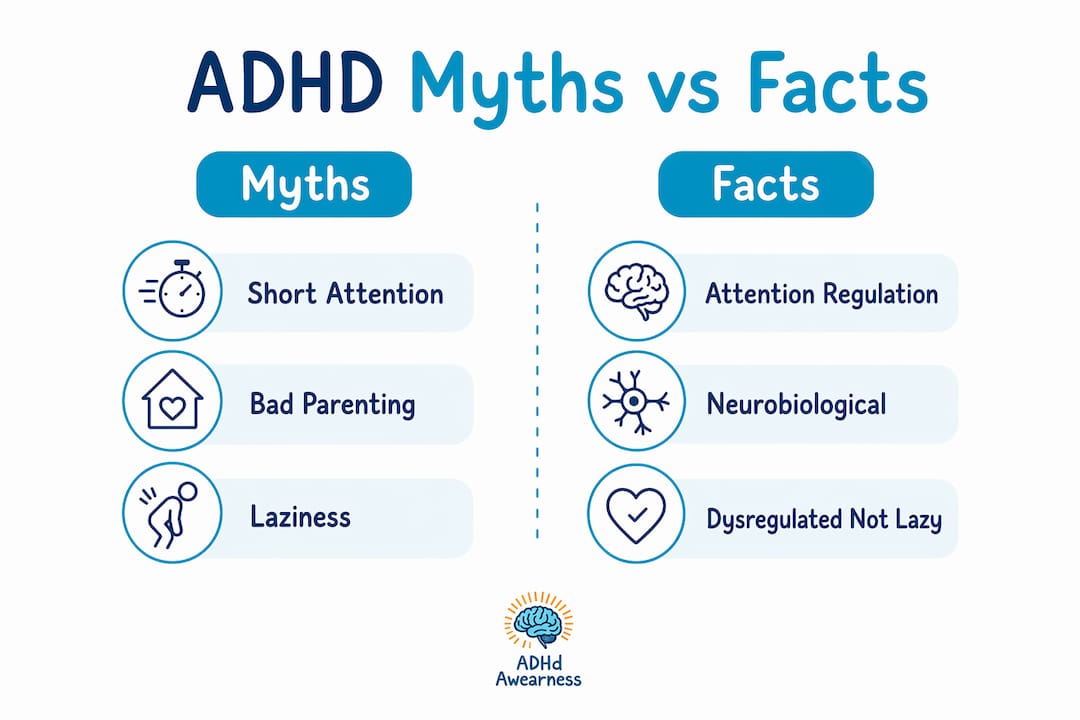
| Myth | Fact |
|---|---|
| ADHD means a short or absent attention span | ADHD is an attention regulation disorder; hyperfocus proves focus is possible |
| ADHD is caused by bad parenting | Twin and family studies confirm ADHD is highly heritable, not a parenting failure |
| ADHD only affects boys or children | Girls and women are frequently underdiagnosed due to inattentive presentations |
| People with ADHD can focus if they try harder | Willpower alone is ineffective due to neurochemical and motivational differences |
| ADHD symptoms disappear in adulthood | ADHD persists into adulthood with shifting but ongoing symptom profiles |
| ADHD is a modern invention | ADHD has been documented since 1798, long before current diagnostic labels existed |
Dr. Barkley frames ADHD as an executive function disorder, not a behavioral or character issue. That framing matters because it shifts the conversation from blame to biology. When a child cannot start a task, it is not defiance. It is a failure of the brain's goal-activation system, which runs on dopamine and requires the right conditions to engage.
Pro Tip: Replace the word "lazy" with "dysregulated" in your vocabulary. Lazy implies choice. Dysregulated describes a neurological state. The language you use shapes the support you offer.
How ADHD attention challenges look different across people and ages
ADHD presents in three ways according to CDC diagnostic criteria: inattentive, hyperactive-impulsive, and combined. Each presentation looks different enough that the same disorder can be invisible in one child and impossible to miss in another. That variability is one reason myths persist.
Girls with ADHD are frequently underdiagnosed because they tend to show inattentive and internalizing symptoms rather than disruptive hyperactivity. A girl who daydreams, forgets assignments, and struggles to organize her thoughts rarely triggers the same concern as a boy who cannot stay in his seat. She may be quietly falling behind for years before anyone connects her struggles to ADHD.
Adult ADHD looks different again. Hyperactivity often diminishes with age, but executive dysfunction persists. Adults describe internal restlessness, difficulty prioritizing tasks, chronic lateness, and trouble sustaining effort on long-term projects. These are not personality flaws. They are the same attention regulation challenges showing up in an adult context. You can read more about how ADHD shifts across life stages and why those shifts matter for diagnosis and support.
Common manifestations across presentations and ages:
- Children: difficulty staying on task, losing materials, impulsive interruptions, emotional outbursts
- Adolescents: procrastination, poor time management, social difficulties, academic underperformance
- Girls and women: daydreaming, people-pleasing, internalized shame, late diagnosis
- Adults: internal restlessness, disorganization, difficulty with long-term planning, masking symptoms until burnout
Masking deserves special attention. Many adults with ADHD have spent years compensating for their symptoms through sheer effort and social mimicry. That process is cognitively exhausting and often leads to burnout before a diagnosis is ever made.
Practical strategies for supporting attention in ADHD individuals
Environment design is the most powerful tool available to parents and educators. Willpower-based strategies consistently fail because they do not address the neurochemical conditions that ADHD attention requires. Interest, novelty, urgency, and challenge are the four conditions that reliably activate the ADHD brain's goal-directed processing. Build those into the task, and focus follows.
For educators, this means connecting assignments to topics the student genuinely cares about wherever possible. It means breaking long tasks into short, clearly defined steps with visible progress markers. It means reducing auditory and visual distractions in the workspace, not as punishment, but as neurological support. The ADHD brain functions differently, and the environment can either work with that or against it.
For parents, the most important shift is moving from "why won't you just do it" to "what does this task need to feel doable." That reframe is not about lowering expectations. It is about understanding that executive function support is as legitimate as a wheelchair ramp.
Best practices for home and classroom settings:
- Use timers and visual schedules to externalize time awareness
- Offer choices within tasks to increase interest and autonomy
- Pair low-interest tasks with a preferred activity as a reward immediately after
- Reduce transition friction by giving advance warnings before switching activities
- Avoid public correction, which increases shame and reduces cognitive bandwidth
- Watch for signs of burnout, including withdrawal, irritability, and sudden drops in performance
Pro Tip: If a student or child seems to "shut down" after a period of high effort, that is often ADHD burnout, not laziness. Rest and recovery are legitimate parts of managing attention regulation.
Why getting this right matters more than most people realize
I have spent years watching the same painful pattern repeat. A child struggles in school, a parent is told to be stricter, a teacher assumes the child is not trying, and everyone doubles down on strategies that make things worse. The myths about ADHD attention span are not harmless misunderstandings. They are the reason children go years without the right support and adults reach their thirties before anyone connects their struggles to a neurological condition they were born with.
What changed my perspective was understanding that ADHD is not a discipline problem wearing a medical label. It is a genuine difference in how the brain regulates attention, and that difference has been documented in research going back to 1798. When I started looking at behavior through that lens, the frustration I used to feel toward "inconsistent" kids shifted into something more useful: curiosity about what the environment or task was missing.
The hardest part of debunking ADHD misconceptions is that the myths feel intuitive. Of course someone who can play video games for hours could focus on homework if they wanted to. That logic makes sense until you understand dopamine-driven attention regulation. Once you understand it, the behavior stops looking like a choice and starts looking like a neurological pattern that needs the right conditions, not the right punishment.
If you are a parent or educator reading this, you are already doing the most important thing: looking for accurate information. That matters. The children and adults in your life who have ADHD do not need more pressure. They need people who understand what is actually happening in their brains.
— Jason
ADHD Awearness: education and advocacy in one place
ADHD Awearness was built on the belief that accurate information changes lives. The organization combines research-backed educational content with a mission to reduce the stigma that myths like these create every day.

Every piece of content on ADHD Awearness is designed to help parents, educators, and individuals understand ADHD as it actually is, not as pop culture has defined it. The store carries 100% USA-made apparel from the ADHD Abilities Collection and beyond, with a portion of every sale supporting ADHD-focused nonprofits. Wearing the message is one more way to keep the conversation going in schools, homes, and communities where it matters most.
FAQ
What is the difference between attention deficit and attention regulation?
Attention deficit implies a uniform inability to focus, while attention regulation describes difficulty controlling when and how focus is directed. ADHD is a regulation disorder, which is why hyperfocus and distractibility can coexist in the same person.
Can people with ADHD really focus for long periods?
Yes. Hyperfocus is a recognized ADHD trait where individuals sustain intense concentration on stimulating tasks for hours. This does not contradict the diagnosis. It confirms that the issue is regulation, not capacity.
Is ADHD caused by bad parenting?
No. Twin and family studies confirm that ADHD is highly heritable and rooted in neurobiology. Dr. Russell Barkley describes it as an executive function disorder, not a behavioral or parenting issue.
Does ADHD go away in adulthood?
ADHD persists into adulthood for most people, though the presentation changes. Hyperactivity often decreases, but executive dysfunction, internal restlessness, and organizational challenges typically continue.
Why are girls with ADHD so often missed?
Girls with ADHD more commonly show inattentive and internalizing symptoms rather than disruptive hyperactivity, so they are less likely to be flagged for evaluation. This leads to later diagnosis and years of unaddressed struggle.