
TL;DR:
- Students with ADHD have impaired working memory, which makes following instructions and completing tasks difficult. Effective support includes breaking instructions into small steps, providing written cues, and using visual schedules. Exercise can improve working memory, but classroom accommodations remain essential for success.
Working memory is defined as the brain's short-term system for holding and using information during active tasks. Students with ADHD consistently show impaired working memory capacity, which makes classroom learning significantly harder than it appears from the outside. The CDC, Understood.org, and research published in Frontiers in Psychiatry all confirm that ADHD and working memory classroom challenges are among the most common and least understood barriers to student success. When you understand exactly what is happening in a student's brain, the right accommodations stop feeling like extra work and start feeling like obvious solutions.

What does ADHD and working memory look like in the classroom?
Working memory functions like a mental sticky note. It holds a phone number long enough to dial it, or keeps step two of an assignment in mind while completing step one. For students with ADHD, that sticky note is smaller, less adhesive, and far easier to wipe clean before the task is done.
The most visible sign of working memory difficulty is losing track mid-task. A student starts an assignment, gets distracted for five seconds, and genuinely cannot remember where they were or what they were supposed to do next. This is not defiance. The information simply did not stay long enough to be used.
Multi-step verbal instructions overwhelm working memory fast. When a teacher says, "Take out your math book, turn to page 47, do problems one through ten, then check your answers with a partner," a student with ADHD may only retain the first or last instruction. The middle steps vanish.
Common classroom behaviors that signal working memory overload include:
- Forgetting materials even after being reminded moments earlier
- Losing their place in a reading passage or written assignment
- Appearing inattentive or "zoned out" during verbal instruction
- Skipping steps in multi-part tasks without realizing it
- Struggling to copy notes from the board while listening to the teacher
These behaviors are frequently misread as laziness or attitude problems. Recognizing them as memory lapses, not defiance is the first shift every educator needs to make.
Pro Tip: Before assuming a student is being difficult, ask yourself: "Did I give more than two verbal steps at once?" If yes, the working memory system may have simply run out of space.
Classroom accommodations that actually reduce working memory demand
Effective ADHD classroom management is not only about behavior. It is about instructional and environmental design that reduces how much a student's brain has to hold at once. The goal is to move memory demands out of the student's head and into the environment around them.
The following strategies are validated by the CDC, Understood.org, and IEP accommodation frameworks used by special education professionals across the country.
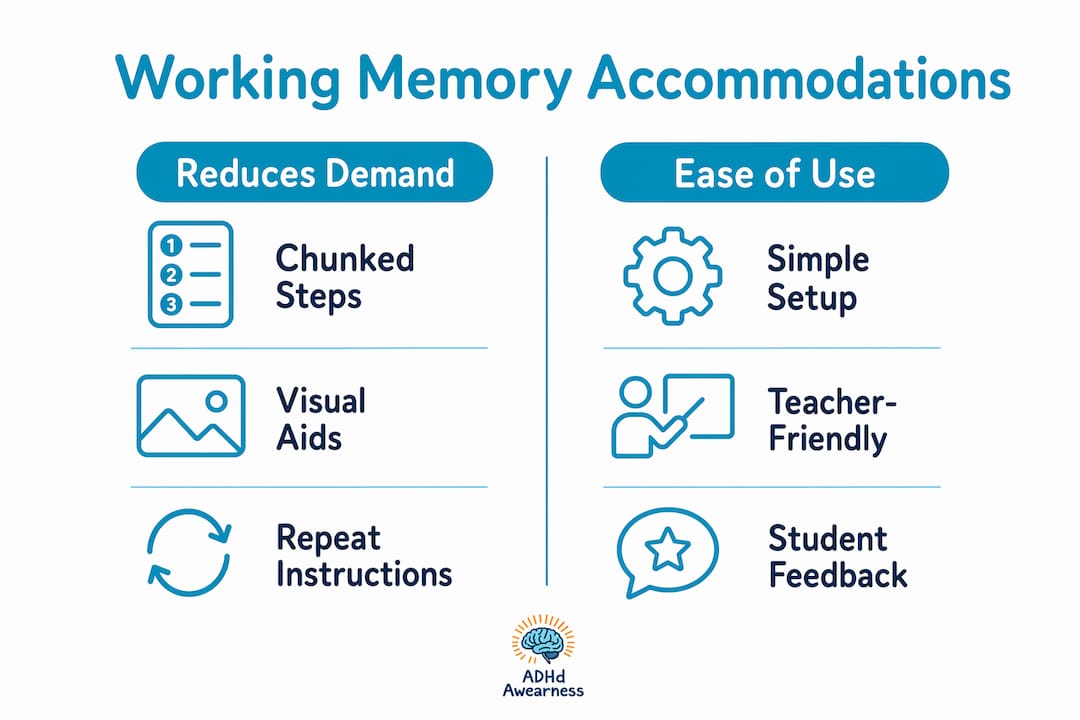
- Chunk verbal instructions to a maximum of two steps. Deliver one or two steps, confirm understanding, then give the next steps. Never front-load a full sequence.
- Pair every verbal instruction with a written version. Post step-by-step directions on the board or provide a printed task card. Written and visual instructions directly reduce working memory burden during seat work.
- Use graphic organizers for writing and reading tasks. These tools externalize the structure of a task so students do not have to hold it mentally while also producing work.
- Post a daily written schedule in a consistent location. Students with ADHD rely heavily on visible routines. A posted schedule removes the need to remember what comes next.
- Use color-coded materials and folders. Color coding reduces the cognitive effort of locating and organizing materials, which frees up working memory for actual learning.
- Seat students near the front and away from high-traffic areas. Proximity to the teacher reduces distraction and makes it easier to re-engage after a lapse.
- Provide advance warnings before transitions. Saying "We have five minutes left before we switch to reading" gives students time to mentally prepare, which prevents the working memory crash that comes with sudden task switching.
The table below compares common accommodation approaches by their primary function and ease of implementation.
| Accommodation | Primary benefit | Ease of implementation |
|---|---|---|
| Chunked verbal instructions | Reduces overload at input | High |
| Posted written schedule | Externalizes routine memory | High |
| Graphic organizers | Offloads task structure | Medium |
| Color-coded folders | Reduces material search time | High |
| Advance transition warnings | Prevents emotional dysregulation | High |
| Seat placement near teacher | Reduces distraction | High |
| Printed task cards | Replaces verbal instruction recall | Medium |
Pro Tip: Have students repeat instructions back to you before starting a task. This one step, recommended by Understood.org, improves encoding and catches misunderstandings before they become errors.
Does exercise improve working memory for students with ADHD?
Physical activity is one of the most promising and underused tools for supporting executive function in students with ADHD. A network meta-analysis published in Frontiers in Psychiatry found that exercise interventions improve working memory in children and adolescents with ADHD. Aerobic exercise showed the highest probability of producing working memory gains, with combined exercise approaches showing an effect size of SMD=0.73. That is a meaningful improvement, not a marginal one.
Practical ways to integrate movement into the school day include:
- Structured movement breaks of five to ten minutes between academic blocks
- Classroom brain breaks using activities like jumping jacks, yoga poses, or walking laps around the room
- Active learning tasks such as standing while reading or walking while reviewing flashcards
- Physical education scheduling placed before high-demand academic periods like math or writing
- Skill-based exercise programs that combine physical and cognitive demands, such as martial arts or dance
The research does carry important caveats. The quality of evidence in this area is still limited, with few high-quality randomized controlled trials. Exercise should complement classroom accommodations, not replace them. An individualized plan that combines movement with environmental supports produces better outcomes than either approach alone.
How to build a school-wide approach to ADHD working memory support
A school-wide approach to supporting working memory in students with ADHD requires administrators to move beyond individual teacher decisions and build consistent systems. Classroom accommodations must be tailored to each student's specific breakdown patterns. A menu of core scaffolds, adjusted through observation, works far better than a single policy applied to every student.
Administrators can lead this work by focusing on the following priorities:
- Train all staff on the difference between working memory deficits and behavioral noncompliance. Teachers who understand ADHD brain wiring respond with accommodation rather than punishment.
- Standardize instruction formats across classrooms. When students experience consistent routines in every room, they spend less working memory managing transitions and more on learning.
- Use observation data to track which supports reduce forgetting. Note when a student loses their place, skips steps, or forgets materials, then adjust the environmental design accordingly.
- Involve families in identifying which home routines reinforce or conflict with school systems. A student whose morning routine is chaotic arrives at school with an already taxed working memory.
- Collaborate with healthcare providers when a student's working memory difficulties are severe. Medication, therapy, and school accommodations work best as a coordinated plan, not in isolation.
The most common mistake administrators make is treating ADHD accommodations as a compliance checkbox rather than a living system. Observation-driven accommodations require regular review, not a one-time IEP meeting.
Pro Tip: Build a shared accommodation menu that teachers can pull from and adapt. A Google Doc or shared drive folder with ready-to-use graphic organizers, task cards, and schedule templates saves time and creates consistency across grade levels.
Common pitfalls in supporting ADHD working memory and how to fix them
Even well-intentioned educators fall into patterns that make working memory challenges worse. Recognizing these pitfalls is the fastest way to improve outcomes for students with ADHD.
The most damaging pitfall is overloading students with verbal instructions without any written backup. A student who cannot hold four steps in mind will not succeed simply because the teacher repeated them louder or slower. The solution is always to externalize the information.
Other common pitfalls include:
- Inconsistent routines. Sudden changes to the daily schedule, even small ones, consume working memory that students need for learning. Advance notice and visual previews of changes prevent emotional dysregulation.
- Misreading memory lapses as defiance. A student who forgets to bring their homework folder for the third time is not being disrespectful. The environmental system around that student has not yet offloaded the memory demand effectively.
- Applying the same accommodation to every student with ADHD. ADHD profiles vary widely. One student may need graphic organizers, and another may need seat placement changes. Observation drives the right fit.
- Removing accommodations too soon. When a student starts succeeding, it is tempting to pull back supports. That success is often because the supports are working, not because the student no longer needs them.
The fix for nearly every pitfall is the same: design the environment to carry the memory load, then observe and adjust. Students with ADHD are not failing to try. The system around them is failing to support how their brain actually works.
What I have learned from watching these strategies in real classrooms
The most effective accommodation I have seen is also the simplest: a laminated task card on every desk. Not a complex system, not a new app. Just a card with two or three steps written in plain language, sitting where the student can see it without asking for help. That small shift removes the shame of forgetting and keeps the student working independently.
What surprises most educators is how quickly behavior improves when working memory demand drops. Students who were labeled as disruptive or unmotivated often become engaged learners within weeks of consistent environmental support. The behavior was never the root problem. The cognitive overload was.
The misconception I push back on hardest is the idea that accommodations give students an unfair advantage. Accommodations level a playing field that was never level to begin with. A student with ADHD using a posted schedule is not getting extra help. They are getting the same access to their own learning that students with typical working memory have automatically.
Patience matters here. These strategies require consistency across every adult in the building, and that takes time to build. But the outcomes, when the system holds, are real. Students remember more, produce more, and feel more capable. That is worth the effort.
— Jason
ADHD Awearness resources for educators and school communities
ADHD Awearness was built on the belief that understanding changes everything. For educators working through the real challenges of supporting students with ADHD, that understanding starts with access to clear, research-based information.

The ADHD Awearness science library offers articles grounded in current research, covering topics from executive function to classroom accommodations. These resources are written for people who want depth without jargon. The ADHD Awearness store also carries awareness apparel made in the USA, with a portion of every sale supporting ADHD-focused nonprofits. Wearing that message into a school building starts conversations that matter. Visit ADHD Awearness to connect with a community that takes these challenges seriously.
FAQ
What is working memory and why does it matter for students with ADHD?
Working memory is the brain's system for temporarily holding and using information during active tasks. Students with ADHD have reduced working memory capacity, which makes following instructions, completing multi-step tasks, and staying organized significantly harder.
What are the most effective classroom accommodations for ADHD working memory?
The most effective accommodations externalize memory demands. These include chunked instructions of no more than two steps, posted written schedules, graphic organizers, color-coded materials, and printed task cards, all validated by CDC and Understood.org guidance.
Can exercise improve working memory in students with ADHD?
Yes. A Frontiers in Psychiatry meta-analysis found aerobic exercise shows the highest probability of improving working memory in children with ADHD, with combined exercise approaches reaching an effect size of SMD=0.73. Exercise works best alongside classroom accommodations, not as a standalone solution.
How can administrators support working memory strategies school-wide?
Administrators should build a flexible menu of accommodations, train all staff to distinguish memory deficits from behavioral issues, standardize instruction formats across classrooms, and use observation data to adjust supports regularly rather than treating IEP accommodations as fixed.
Why do students with ADHD keep forgetting things even after being reminded?
Reminders delivered verbally are processed through the same working memory system that is already impaired. The information does not encode reliably. Written reminders, visual cues, and environmental supports bypass this limitation by keeping the information visible without requiring the student to hold it mentally.