
TL;DR:
- Communicating with someone who has ADHD requires adjusting your approach to match how their brain processes information. Small changes in speech, environment, and timing can significantly improve understanding and connection.
Communicating effectively with an ADHD person means structuring your words, timing, and environment to match how the ADHD brain actually processes information. Attention-Deficit/Hyperactivity Disorder affects executive function, working memory, and impulse control. Those three things sit at the core of every conversation. When you understand that, frustration gives way to clarity. The good news is that small, deliberate changes in how you speak, listen, and follow up can transform your connection with a friend, family member, or colleague who has ADHD.
What are the key challenges in communicating with a person who has ADHD?
ADHD disrupts the cognitive systems that make conversation feel effortless for most people. Multiple executive functions are taxed during real-time conversation, including working memory, impulse control, and attention regulation. That means a person with ADHD is often managing several cognitive demands at once just to stay present in a discussion.
The most common challenges you will encounter include:
- Difficulty sustaining focus. A person with ADHD may lose the thread of a conversation mid-sentence, not because they stopped caring, but because their attention shifted involuntarily.
- Slow or uneven processing speed. They may need more time to formulate a response than the natural rhythm of conversation allows.
- Emotional reactivity. ADHD often amplifies emotional responses, making disagreements feel more intense than intended.
- Impulsive interruptions. Interruptions and abrupt responses from ADHD individuals are typically caused by executive function challenges, not disrespect. Recognizing that distinction changes everything.
- Off-topic responses. A thought that feels directly connected to the person with ADHD may seem unrelated to you. Their associative thinking moves fast.
"Communicating with someone who has ADHD is not about lowering your expectations. It is about adjusting the conditions so their full intelligence and care can actually reach you."
These breakdowns happen at the neurological level, not the motivational one. A person with ADHD is not choosing to zone out or cut you off. Their brain is working differently, and your communication approach needs to account for that reality. When you stop interpreting these behaviors as personal, the whole dynamic shifts.
How should you structure conversations for better understanding?
Preparation is the single most underrated tool for ADHD communication. Low-distraction environments, one topic at a time, and extra processing time are the foundation of any productive conversation with a person who has ADHD. Choosing a quiet room over a busy coffee shop is not a small preference. It is the difference between a conversation that lands and one that gets lost.
Here is a practical framework for structuring conversations:
- Choose the right setting. Find a calm, low-stimulus space. Turn off the TV, step away from the open office floor, and silence notifications.
- Set a topic agenda. Let the person know in advance what you want to discuss. A simple text saying "I'd like to talk about the weekend plans tonight" removes the anxiety of surprise and gives their brain time to prepare.
- Focus on one topic per conversation. Stacking multiple issues in one sitting overloads working memory. Save secondary topics for a separate check-in.
- Build in pauses. Silence is not awkward. It is processing time. Slowing your pace and allowing pauses reduces missed details and gives the other person space to think clearly.
- Use visual aids or notes. Writing key points on paper or a shared screen externalizes information and reduces the load on working memory.
- Schedule regular check-ins. Planned daily or weekly conversations remove the pressure of spontaneous, high-stakes discussions. Consistency builds trust and reduces anxiety for both of you.
| Strategy | Why it works | When to use it |
|---|---|---|
| Low-distraction setting | Reduces cognitive load | Every important conversation |
| Single-topic focus | Protects working memory | Anytime you have multiple concerns |
| Advance notice | Allows mental preparation | Before sensitive or complex topics |
| Scheduled check-ins | Builds routine and reduces anxiety | Ongoing relationships |
| Visual notes | Externalizes memory | Planning, decisions, and recaps |
Pro Tip: Send a brief agenda text before any important conversation. Even one sentence like "Can we talk about the budget tonight?" gives an ADHD brain time to shift gears and show up ready.

What communication techniques improve real-time discussions?
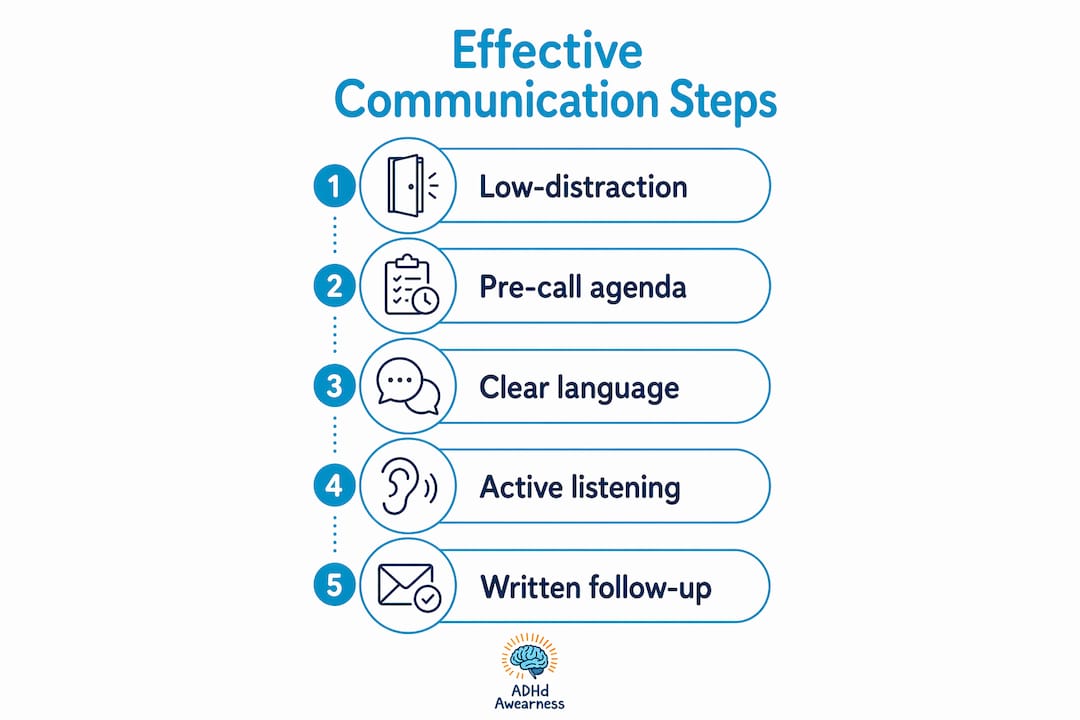
The way you speak during a conversation matters as much as the setting. Using concrete, behavior-based language rather than vague character judgments is one of the most effective shifts you can make. "You left the dishes in the sink three times this week" is specific and workable. "You're so disorganized" triggers shame and shuts the conversation down.
Real-time techniques that consistently improve ADHD conversations include:
- Speak slowly and clearly. A measured pace gives the other person time to process each idea before the next one arrives.
- Ask clarifying questions. Phrases like "Can you say more about that?" serve two purposes. They buy processing time and signal genuine engagement to the person with ADHD.
- Avoid multitasking. Checking your phone while talking sends a signal that the conversation is not important. Full presence is non-negotiable.
- Pause before responding. Giving yourself a beat before replying models the kind of thoughtful pacing that helps the whole conversation slow down.
- Reflect feelings before problem-solving. Listening to understand rather than listening to respond builds trust and reduces defensiveness. Say "It sounds like you felt left out" before jumping to solutions.
Pro Tip: Replace "You never listen" with "When I feel unheard, I shut down. Can we try again?" Behavior-based language keeps the conversation about the situation, not the person's character.
Active listening is not passive. It requires you to track what is being said, reflect it back, and resist the urge to fill every silence. For a person with ADHD, that kind of attentive presence is genuinely rare and deeply valued.
How can written communication support ADHD conversations?
Written communication gives both parties a slower lane. Written follow-up helps catch missed details and reduce conflict after real-time exchanges. A quick recap text or email after an important conversation is not redundant. It is a safety net for working memory.
Here is how to use written communication effectively:
- Send a recap after key conversations. A short message like "Just to confirm: we agreed to split the grocery run on Saturday" prevents misunderstandings before they grow.
- Use bullet points for complex information. Externalizing information through notes and single-step instructions reduces the cognitive load that comes with holding multiple ideas in mind at once.
- Choose text or email over in-person for non-urgent topics. Written messages give the person with ADHD time to read, process, and respond without the pressure of an immediate reply.
- Keep messages short and direct. Long paragraphs are hard to parse for anyone with attention challenges. One idea per message works best.
- Use written communication to set agendas. Sending a brief outline before a meeting or family discussion gives the ADHD brain time to prepare, which dramatically improves the quality of the conversation that follows.
Written communication is not a workaround. It is a legitimate and often superior channel for people with ADHD. Treat it as a core part of your communication strategy, not an afterthought.
What strategies help manage emotional moments and breakdowns?
Emotional escalation is one of the most common and most painful parts of communicating with a person who has ADHD. The key is to have a system in place before things get heated, not during the moment itself.
Strategies that consistently reduce conflict include:
- Agree on a timeout signal in advance. A hand signal or a phrase like "let's revisit in 30 minutes" gives both people permission to step back without it feeling like abandonment or defeat.
- Normalize private feedback on tone and body language. People with ADHD often do not realize when their volume or expression reads as hostile. Asking privately, "Did you know your tone came across as sharp?" is far more effective than reacting in the moment.
- Acknowledge feelings before problem-solving. Jumping straight to solutions when someone is emotionally activated rarely works. A simple "I hear you, that sounds really frustrating" creates the safety needed to move forward.
- Do not fill silences prematurely. Silence after an emotional moment is often the person with ADHD organizing their thoughts. Rushing to fill it cuts that process short.
"Slowing conversations and modeling emotional regulation, including suggesting pauses, reduces conflict in ADHD communications." — Key Counseling Group
The goal is not to avoid all conflict. The goal is to build a system where conflict does not spiral. When both people know the rules of engagement, the ADHD person feels safer, and you feel less blindsided.
What I have learned about communicating with ADHD individuals
After spending years working alongside people with ADHD and studying how communication breaks down, one thing stands out above everything else: the biggest mistake people make is treating ADHD communication as a problem to fix rather than a style to understand.
You are not trying to get the ADHD person to communicate like a neurotypical person. You are designing a conversation structure that lets their actual intelligence and warmth come through. That is a completely different goal, and it changes your whole approach. When I started thinking about it that way, I stopped feeling frustrated and started feeling curious.
The strategies in this article are not about asking someone to mask their ADHD. Effective communication with ADHD is about designing interaction pace, clarity, and structure rather than suppressing natural traits. That distinction matters deeply. Masking is exhausting and harmful. Adapting your communication style is respectful and sustainable.
One more thing: this is not a one-time adjustment. The best communicators I have seen in ADHD relationships keep learning, keep asking for feedback, and keep adapting. They treat it as an ongoing practice, not a problem they solved once. That mindset is what makes the difference. You can find more on building that kind of consistent support through an ADHD accountability partnership, which applies many of these same principles to everyday routines.
— Jason
ADHD Awearness: resources to help you connect and advocate
ADHD Awearness is built for exactly this kind of learning. Whether you are a parent trying to support an adult with ADHD, a partner working through communication patterns, or a colleague wanting to show up better, ADHD Awearness offers blogs, videos, and podcasts that make these concepts real and accessible.

The ADHD Awearness store also carries 100% USA-made apparel designed to spark conversations and support ADHD-focused nonprofits with every purchase. Wearing that message into your daily life is its own form of advocacy. Browse the ADHD Abilities Collection to find something that speaks to your experience and helps fund the education that makes these conversations possible.
FAQ
What is the ADHD communication style?
The ADHD communication style is characterized by impulsive responses, difficulty sustaining focus, emotional reactivity, and associative thinking that can make conversations feel unpredictable. These traits stem from differences in executive function, not intention or attitude.
How do I communicate ADHD needs to parents or loved ones?
Use specific, behavior-based language and choose a calm, low-distraction setting for the conversation. Written follow-up after the discussion helps clarify any points that were missed or misunderstood.
How can I build rapport with an ADHD student or colleague?
Schedule consistent check-ins, use clear and concrete language, and follow up in writing after important discussions. Reliability and patience build trust faster than any single technique.
Why does a person with ADHD interrupt so often?
Interruptions are typically caused by impaired impulse control, not disrespect. The ADHD brain generates responses quickly and struggles to hold them in working memory long enough to wait for a natural pause.
Does written communication really help with ADHD?
Written messages give the person with ADHD time to process tone and content without the pressure of an immediate response. Follow-up texts or emails after conversations reduce misunderstandings and support recall of key details.