

Support in ADHD adult life is defined as the combination of emotional validation, informational guidance, and practical assistance that enables adults with Attention-Deficit/Hyperactivity Disorder to manage daily functioning and build meaningful lives. The role of support in ADHD adult life goes far beyond medication or therapy alone. Research confirms that strong support systems produce better emotional regulation, stronger treatment adherence, and reduced shame. Organizations like ADDA, CHADD, and Adhdawearness have each recognized that peer connection, workplace accommodation, and community belonging are not optional extras. They are the foundation adults with ADHD need to thrive.
What is the role of support in ADHD adult life?
Support systems for adults with ADHD fall into three distinct categories, and each one serves a different function in daily life. Emotional support addresses the loneliness, shame, and frustration that often accompany ADHD. Informational support delivers strategies, coaching, and knowledge that help you understand your own brain. Practical support covers the tangible help that makes life workable, from accountability partners to workplace accommodations.
Understanding how the ADHD brain functions explains why all three types matter. Executive function deficits make it genuinely harder to initiate tasks, manage time, and regulate emotions. Without external scaffolding, these challenges compound. Support is not a crutch. It is the external structure that compensates for what the ADHD brain struggles to generate on its own.

CHADD's 2026 research study on how adults aged 25–65 use everyday support strategies underscores just how central this question is to the field. The study's focus on real-world functioning confirms that researchers now treat support as a primary variable in ADHD outcomes, not an afterthought.
What types of support are most effective for adults with ADHD?
The importance of support in ADHD is clearest when you break it down by type and match each type to a specific need. Not all support is interchangeable, and using the wrong kind for the wrong situation creates frustration on both sides.
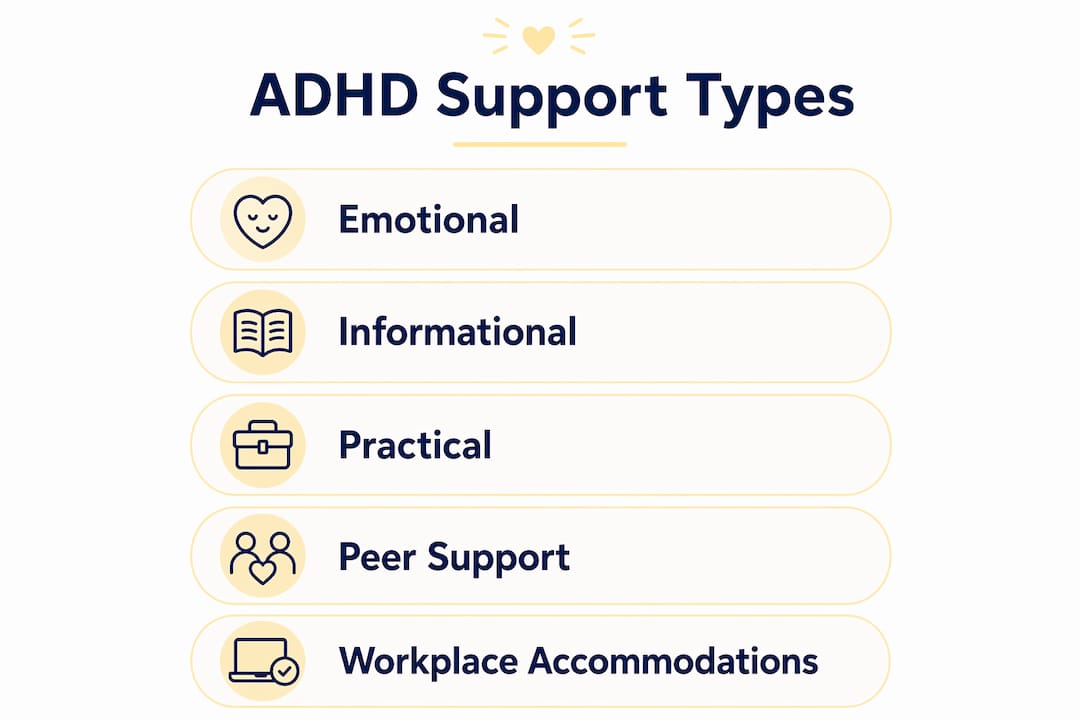
Emotional support reduces the isolation that many adults with ADHD carry silently. This includes validation from friends, family, or peer groups who understand that ADHD is neurological, not a character flaw. When someone says "that makes sense given how your brain works," it lowers cortisol and opens the door to problem-solving.
Informational support is where executive function coaching earns its reputation. Coaches trained in ADHD help you build systems for time management, task initiation, and prioritization. Tools like time-blocking apps, body-doubling sessions, and structured planning methods all fall under this category.
Practical support is the most concrete form. It includes:
- Workplace accommodations such as flexible deadlines or noise-canceling headphones
- Accountability partners who check in on specific goals
- Household systems designed around ADHD tendencies, like visual schedules and designated drop zones
- Digital tools such as Todoist, Notion, or Google Calendar set up with ADHD-friendly reminders
Pro Tip: When asking someone for support, name the type you need. Say "I need you to just listen right now" or "Can you help me break this task into steps?" Specificity prevents the most common support mismatch: someone offering advice when you needed empathy.
ADHD-focused Facebook groups provide all three support types simultaneously, which is why they attract such consistent engagement. Participants describe these spaces as places where practical advice on time management and digital tools coexists with genuine emotional acceptance.
How does peer support uniquely benefit adults with ADHD?
Peer support does something clinical treatment cannot fully replicate: it creates belonging. When you sit in a room, or a virtual group, with people who lose their keys, forget appointments, and feel overwhelmed by ordinary tasks, the shame lifts. That shift is not trivial. Shame is one of the biggest barriers to seeking help and following through on treatment.
ADDA's virtual peer support groups demonstrate how specialization amplifies this effect. ADDA offers programs including ADHD@ Work Survive & Thrive, Entrepreneurs with ADHD, and identity-based groups organized around demographics and lived experience. Specializing peer support by work context, demographics, and identity improves both relevance and engagement for adults with ADHD. A group designed for ADHD entrepreneurs speaks to challenges a general support group simply cannot address with the same precision.
Peer support also functions as a buffer against executive dysfunction. When reaching out feels like too much effort, a scheduled group meeting removes the initiation barrier. You show up because it is already on the calendar, and the community does the rest.
"These groups are safe spaces offering acceptance, encouragement, and practical advice." This is how participants in ADHD-focused peer communities describe their experience, according to research on adult ADHD Facebook groups. That combination of safety and practicality is rare and worth protecting.
The social function of peer groups extends beyond emotional relief. Regular participation builds a sense of identity around ADHD that is affirming rather than stigmatizing. You stop seeing ADHD as something that disqualifies you and start seeing it as a shared experience with a community behind it.
What challenges exist in getting support at work and home?
ADHD adult life challenges around support are most acute in two places: romantic relationships and workplaces. Both settings involve people who care about you or are obligated to work with you, yet support gaps persist.
Research involving 286 adults with ADHD found a consistent pattern: symptom severity correlates with higher desire for support but lower perceived support received. This is the support gap. It does not mean partners are failing. It means ADHD symptoms, especially emotional dysregulation, distort how support is perceived and communicated.
Emotional dysregulation makes neutral interactions feel dismissive. A partner who says "just write it down" may intend to help, but an ADHD brain in distress hears criticism. This is why specifying the form of support needed reduces miscommunication and increases support effectiveness. The fix is not more support. It is clearer support.
In the workplace, the process looks like this:
- Identify the functional difficulty, not the diagnosis. You do not have to disclose ADHD to request an accommodation under the Americans with Disabilities Act.
- Submit a written request describing how the difficulty affects your work performance.
- Engage in the interactive process with HR, which involves discussing possible accommodations.
- Implement the agreed accommodation. Common accommodations may be in place within 2–4 weeks of request.
Pro Tip: Before your HR meeting, write down three specific work tasks that your ADHD symptoms make harder. Concrete examples move the conversation from abstract to solvable, and they make the accommodation request far more persuasive.
The comparison below shows how support gaps differ by setting and what closes them:
| Setting | Common Gap | What Closes It |
|---|---|---|
| Romantic relationships | Emotional support perceived as insufficient | Naming the type of support needed before the conversation |
| Workplace | Practical accommodations not requested | Using ADA process with functional, not diagnostic, language |
| Peer groups | Wrong group for specific need | Routing to specialized groups by context or identity |
How can you build a personalized ADHD support network?
Building a support network for adults with ADHD works best when you treat it as ongoing scaffolding rather than a one-time setup. Executive function deficits mean that reaching out when you need help is hardest precisely when you need it most. The solution is to build the system before the crisis arrives.
Here is a practical framework:
- Map your support needs by type. List the people in your life and assign each one a primary support role: emotional, informational, or practical. Your therapist provides emotional and informational support. Your ADHD coach provides informational and practical support. Your accountability partner provides practical support.
- Prepare pre-written messages. Draft three short messages you can send when you are overwhelmed: one asking for a listening ear, one asking for help breaking down a task, and one asking someone to check in on a goal. Store them in your phone's notes app.
- Join at least one peer group. ADDA's virtual programs or ADHD-focused communities on platforms like Reddit or Facebook give you access to people who understand your experience without explanation.
- Combine professional and peer support. Medication manages symptoms. Therapy addresses co-occurring conditions. Peer groups reduce isolation. Coaching builds daily systems. No single source covers everything.
Routing support needs to distinct spaces optimizes outcomes. Send informational questions to advice forums. Bring emotional needs to safe peer spaces. Build social belonging through consistent participation in a regular group. This segmentation prevents any one person or group from carrying too much of your support load.
The Adhdawearness blog offers additional resources on living with ADHD, including strategies for emotional regulation and community connection that complement the network you are building.
Key takeaways
Strong support systems for adults with ADHD require matching the right type of support to the right need, because emotional, informational, and practical support each address distinct challenges that ADHD creates.
| Point | Details |
|---|---|
| Three support types matter | Emotional, informational, and practical support each serve a different function in ADHD management. |
| Peer groups reduce isolation | Specialized groups like ADDA's virtual programs create belonging and lower shame more effectively than general communities. |
| Support gaps are real | Adults with ADHD often perceive less support than partners intend to give; naming the type needed closes the gap. |
| Workplace accommodations are accessible | Under the ADA, you can request accommodations by describing functional difficulties without disclosing your diagnosis. |
| Build the network before crisis hits | Pre-written messages and organized contacts by support type make reaching out possible when executive function is low. |
Why i think most adults with ADHD are undersupported, not undertreated
After spending years reading the research and talking with adults who live with ADHD every day, one pattern stands out clearly. Most adults with ADHD are not failing because they lack the right medication or the right diagnosis. They are failing because their support network is either absent or mismatched.
The clinical world does a reasonable job of identifying ADHD and prescribing treatment. What it does not do well is help you build the human infrastructure around that treatment. Medication can sharpen focus for a few hours. It cannot tell your partner what kind of support you need tonight. It cannot show up to your accountability check-in on Tuesday. It cannot sit in a peer group and remind you that you are not alone.
What I find most underappreciated is the role of specificity. Adults with ADHD often know they need help but cannot articulate what kind. That vagueness leads to support that misses the mark, which then feels worse than no support at all. Learning to say "I need you to validate me right now, not fix this" is a skill. It takes practice. But it changes relationships.
The stigma piece matters too. Adhdawearness was built around the idea that awareness changes conversations. When you wear a message, carry a story, or share an article, you lower the barrier for someone else to ask for help. That is not small. That is how support systems grow.
My honest recommendation: treat your support network like a living document. Review it every few months. Add people. Remove relationships that consistently miss your needs. Be specific about what you are asking for. The adults with ADHD who thrive are not the ones with the fewest symptoms. They are the ones with the most intentional support around them.
— Jason
How Adhdawearness supports your ADHD journey
Building a support network starts with finding your community, and Adhdawearness exists to help you do exactly that. Through educational content, awareness campaigns, and a growing community of adults who get it, Adhdawearness makes it easier to start the conversations that matter.
Every purchase from the Adhdawearness store supports ADHD-focused nonprofits directly. The 100% USA-made apparel is designed to spark real conversations, the kind that open doors to support you did not know was available. Whether you are looking for community, resources, or a way to show the world that ADHD is worth understanding, Adhdawearness is a place to start. Wear the message. Build the network.
FAQ
What is the role of support in ADHD adult life?
Support in ADHD adult life provides the emotional validation, informational guidance, and practical assistance that compensate for executive function deficits. Strong support systems improve emotional regulation, treatment adherence, and daily functioning.
How does peer support help adults with ADHD?
Peer support reduces isolation and shame by creating a sense of belonging among people with shared experiences. Specialized groups like ADDA's virtual programs improve outcomes by matching support to specific life contexts such as work or identity.
What is the support gap in ADHD relationships?
The support gap occurs when adults with ADHD desire more support than they perceive receiving from partners. Research on 286 adults shows that symptom severity increases this gap, and naming the specific type of support needed is the most effective way to close it.
Can adults with ADHD request workplace accommodations without disclosing their diagnosis?
Yes. Under the Americans with Disabilities Act, you can request accommodations by describing functional difficulties rather than naming your diagnosis. Common accommodations can be implemented within 2–4 weeks of a formal request.
What is the fastest way to build an ADHD support network?
Map your existing contacts by support type, join one specialized peer group, and prepare pre-written messages for moments when reaching out feels too hard. Combining professional help, peer community, and practical accountability covers the full range of support needs.