

TL;DR:
- ADHD time management deficit is caused by time blindness, which affects the brain's ability to perceive time passing accurately.
- External tools like visual timers, structured routines, and accountability partnerships help compensate for neurological challenges.
ADHD time management deficit is defined by a neurological symptom called time blindness, an impaired ability to accurately perceive and estimate the passage of time. This is not a character flaw or a failure of effort. Dr. Russell Barkley, one of the leading researchers in ADHD, describes ADHD as a disorder of doing what you know at the right time, not a disorder of knowing what to do. That distinction changes everything. For people with ADHD, the brain's internal clock runs differently, making chronic lateness, missed deadlines, and poor task shifting daily realities rather than occasional slip-ups.
What is ADHD time management deficit, and why does it happen?
ADHD time management deficit is rooted in a condition called time blindness, and it goes far deeper than forgetting to check the clock. The ADHD brain struggles to sense time passing in real time. A person may sit down to work for "a few minutes" and look up two hours later, or feel certain a task will take 20 minutes when it actually requires 90. According to Henry Ford Health, time blindness affects prioritization and time allocation, frequently causing people to underestimate durations or over-fixate on current activities. That means the problem is not awareness of time as a concept. It is the brain's failure to feel time moving.

Executive dysfunction sits at the core of this challenge. Executive functions are the mental skills that help you plan, prioritize, start tasks, and shift between them. In ADHD, these functions are impaired at a neurological level, not a motivational one. The prefrontal cortex, which governs executive function, develops more slowly in people with ADHD and operates with less consistency. This makes it genuinely harder to organize a morning routine, estimate how long a project will take, or stop one task and begin another.
Dopamine also plays a central role. Research from the Icahn School of Medicine at Mount Sinai found that motivation scores in ADHD participants averaged 11±5 on standardized scales, compared to 14±3 in controls (P<0.001), directly correlating with dopamine receptor availability. Lower dopamine means the brain struggles to generate the internal drive needed to start or sustain tasks, especially ones that feel distant or unrewarding.
One concept that helps explain the daily experience is "time horizon narrowing." The ADHD brain tends to treat the near future as vivid and real, while anything beyond the next hour feels abstract and unimportant. A deadline three days away might as well be three years away, until it is suddenly three hours away. That is not procrastination in the traditional sense. It is a genuine perceptual gap.
Pro Tip: If you or someone you support has ADHD, try narrating time out loud. Saying "I have 20 minutes before I need to leave" while looking at an analog clock activates both verbal and visual processing, which helps anchor time perception more effectively than a silent digital display.
How does ADHD motivation deficit make time struggles worse?
The ADHD motivation deficit compounds time blindness in a way that creates a painful cycle. When dopamine pathways are dysregulated, the brain does not generate the same anticipatory reward signal that drives most people to start tasks. The result is that people with ADHD often cannot will themselves to begin something, even when they fully understand its importance. This is sometimes called ADHD paralysis, and it is not laziness. It is a neurological stall.
The brain defaults to immediate rewards because those feel real and accessible. A task due next week produces almost no dopamine signal today. Scrolling a phone or watching a video produces one immediately. This is why people with ADHD often describe knowing exactly what they need to do but feeling completely unable to start. The executive function gap explains why internal willpower alone rarely solves the problem.
The emotional weight of this cycle is significant. Repeated experiences of missing deadlines, being late, or abandoning tasks mid-way generate feelings of frustration, guilt, and shame. Over time, those feelings can become their own barrier, making it even harder to attempt tasks. Educators and family members who see this pattern from the outside often misread it as indifference or defiance.
Strategies that actually help address the motivation gap directly:
- Break tasks into the smallest possible steps, so each micro-step delivers a small sense of completion.
- Use external accountability, such as a body double, a check-in partner, or a structured coaching session.
- Attach immediate, concrete rewards to task completion rather than relying on the distant reward of "getting it done."
- Set a two-minute rule: commit only to starting a task for two minutes. Starting is the hardest part.
- Use ADHD accountability partnerships to build consistent external structure.
These approaches work because they replace the missing internal signal with an external one. They do not require the ADHD brain to suddenly function differently. They meet the brain where it is.
What are common misconceptions about ADHD time management deficits?
The most damaging misconception is that ADHD time management struggles reflect laziness or a lack of caring. This belief causes real harm. When a person with ADHD is repeatedly told they just need to try harder, they internalize the message that they are fundamentally flawed. The research says otherwise.
"Labeling ADHD time management issues as laziness is a major misconception. Effective support requires shifting from shame to external structure and understanding of neurodevelopmental differences. Experts emphasize the need for externalized systems rather than relying on internal willpower."
Source: HuffPost Life, "ADHD Time Blindness: Why You Seem Flaky Or Always Late"
ADHD is a neurodevelopmental condition, not a personality trait. The neurodevelopmental differences that drive time blindness are present in brain structure and chemistry, not in attitude or character. A person with ADHD who arrives late to every meeting is not disrespecting others. Their brain is genuinely failing to signal the urgency of departure time.
A second misconception is that people with ADHD can manage time fine when they "really want to." Hyperfocus, the ability to lock in intensely on a highly stimulating task, is real. But it is not evidence of control. Hyperfocus is the same dysregulation working in reverse, where the brain cannot disengage rather than cannot engage. It does not prove that time management is a choice. Addressing these attention span myths is the first step toward building genuine understanding.
Shifting away from shame-based thinking is not just compassionate. It is practical. When people with ADHD stop spending energy on self-blame, they free up cognitive resources to actually use the strategies that work.
What practical strategies help manage ADHD time management challenges?
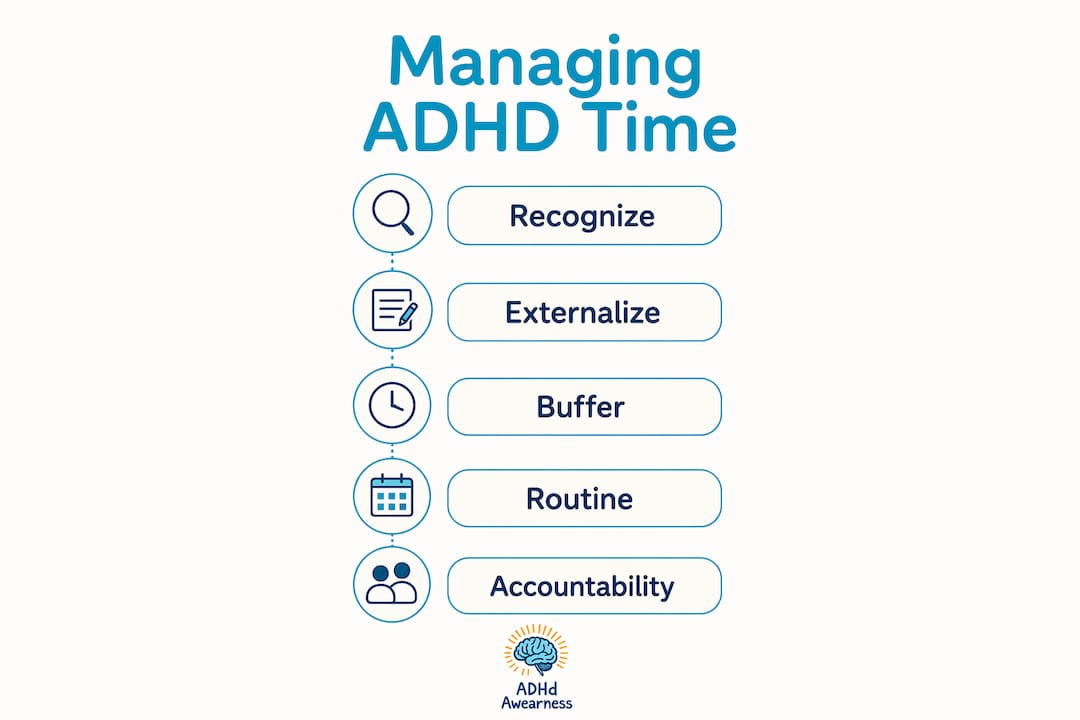
Managing ADHD time management challenges requires externalizing time, which means making time visible, audible, and physical rather than relying on internal awareness. The brain cannot feel time passing reliably, so the environment must do that work instead.
Use physical tools that make time visible
Analog clocks and mechanical timers give a visual representation of time passing that digital displays cannot match. Their moving hands provide a tangible, continuous cue. Digital alarms often get ignored because they are easy to dismiss. A physical timer sitting on a desk, counting down visibly, keeps time in the field of awareness without requiring active attention.
Build buffers into every transition
Adding a 15-minute buffer to every time estimate accounts for the ADHD tendency to underestimate preparation and transition time. If you think leaving at 9:00 AM will get you there on time, plan to leave at 8:45 AM. This single habit reduces chronic lateness more reliably than any app or reminder system.
Follow a structured daily routine
Consistent routines reduce the number of decisions the executive function system must make each day. When the sequence of morning tasks is the same every day, the brain stops having to plan and starts running on pattern. Structured support over 90–180 days produces measurable improvements in time control and daily organization.
Here is a practical framework for building time management structure:
- Anchor your day to fixed events. Choose two or three non-negotiable time markers, such as wake time, lunch, and a wind-down routine, and build everything else around them.
- Use visual task lists. Write tasks on a whiteboard or sticky notes placed where you will see them, not buried in an app.
- Set layered alarms. Use one alarm 30 minutes before a deadline and another 10 minutes before. Two signals are harder to ignore than one.
- Schedule transition time explicitly. Treat the time between tasks as a task itself. Block it on your calendar.
- Review your day the night before. A five-minute preview of tomorrow's schedule reduces morning decision fatigue significantly.
| Strategy | What it addresses | Time to see results |
|---|---|---|
| Analog clock or timer | Time blindness | Immediate |
| 15-minute buffer rule | Chronic lateness | 1–2 weeks |
| Consistent daily routine | Executive dysfunction | 90–180 days |
| Accountability partner | Motivation deficit | 2–4 weeks |
| Visual task list | Task initiation | Immediate |
Medication is part of the picture for many people, but medication alone is not enough. Henry Ford Health experts recommend pairing medication with coaching, environmental modifications, and personalized systems. The goal is a layered approach where each element compensates for what the ADHD brain cannot reliably supply on its own.
Pro Tip: The most overlooked strategy is externalizing accountability through another person, not an app. A weekly check-in call with a coach or trusted friend activates social motivation, which is one of the strongest dopamine triggers available to the ADHD brain.
What living with ADHD time challenges has taught me
People talk a lot about strategies, and strategies matter. But the part that rarely gets enough attention is the emotional exhaustion of living inside a brain that constantly fights you on time. I have watched people with ADHD spend more energy beating themselves up for being late than they ever spent on the task itself. That self-blame is not just painful. It actively makes the problem worse.
The neurobiology here is not abstract. When shame floods the system, the prefrontal cortex, already the weakest link in the ADHD chain, shuts down further. You cannot shame someone into better executive function. You can only make it harder for them to access what little they have.
What I have found actually works is building systems before the crisis hits. Most people wait until they have missed something important before they take structure seriously. The families and individuals who make real progress are the ones who treat time management tools the same way they treat glasses for poor vision: not as a crutch, but as a necessary correction for how the brain works. For families navigating this together, support in ADHD adult life is a resource worth reading alongside this one.
Patience with the process is not optional. Habit formation takes months, not days. Expecting a new routine to stick in two weeks sets everyone up for disappointment. Expecting it to stick in four to six months, with consistent support, is realistic.
— Bruce
How ADHD Awearness supports people managing time deficits
ADHD Awearness exists to replace stigma with understanding, and that mission extends directly to the time management challenges that affect so many people with ADHD every day.

ADHD Awearness produces educational blogs, videos, and podcasts that explain the neuroscience behind ADHD in plain language. The community resources help families and educators move from frustration to informed support. The ADHD Awearness store carries 100% USA-made apparel designed to spark real conversations about neurodiversity, with a portion of every sale supporting ADHD-focused nonprofits. The Abilities Collection is a strong starting point for anyone who wants to wear their support visibly. Education and advocacy work best when they move together.
FAQ
What is ADHD time blindness?
ADHD time blindness is an impaired ability to accurately perceive and estimate the passage of time. It causes chronic lateness, difficulty shifting tasks, and poor time allocation, and it is driven by executive dysfunction and dopamine dysregulation.
Is ADHD time management deficit the same as laziness?
No. ADHD time management deficit is a neurodevelopmental condition rooted in brain structure and dopamine pathways. Labeling it as laziness is a misconception that prevents effective support and increases shame without improving outcomes.
What is ADHD motivation deficit?
ADHD motivation deficit refers to the brain's reduced ability to generate the internal drive needed to start or sustain tasks. Research links it directly to lower dopamine receptor availability, with ADHD participants scoring significantly lower on motivation scales than controls.
How long does it take to improve ADHD time management?
Consistent structure and coaching typically require 90–180 days to produce measurable improvements in time control and daily organization. Expecting faster results leads to discouragement and early abandonment of effective strategies.
What tools help most with ADHD time management?
Analog clocks, mechanical timers, visual task lists, layered alarms, and accountability partners are the most effective tools. These work by externalizing time and motivation, compensating for the ADHD brain's unreliable internal signals.