

An ADHD accountability partnership is a structured, goal-focused relationship where two people with ADHD help each other stay on track through regular check-ins, shared commitments, and curiosity-based communication. This is different from body doubling, which ADHD coach Linda Anderson coined in 1996 as silent, parallel presence support. An accountability partner actively tracks your goals and follows up. When you start an ADHD accountability partnership with the right structure, you get something more powerful than motivation: you get an external system that bridges the gap between intention and action, which is exactly where the ADHD brain struggles most.
What mindset and preparation do you need first?
The most common mistake people make before starting an ADHD accountability partnership is choosing the wrong partner. Family members and romantic partners often struggle in this role because existing emotional tensions compromise neutrality and increase resentment over time. A peer, colleague, or someone from an ADHD community group makes a far better fit. Neutral ground matters.
Beyond partner selection, your mindset sets the tone for everything. Effective ADHD partner support runs on curiosity, not judgment. That means replacing "why didn't you do it?" with "what got in the way?" This single shift, recommended by accountability experts, prevents the shame spiral that shuts down motivation in people with ADHD. Shame is not a motivator. It is a blocker.
You also need to decide on your tools before your first meeting. Options include:
- Text check-ins via iMessage or WhatsApp for low-pressure daily contact
- Video calls via Zoom or Google Meet for structured weekly sessions
- Apps like UpOrbit, which provide externalized task reminders and commitment tracking built specifically for ADHD workflows
- Community groups like ADDA Turbo Tuesdays for peer-led virtual co-working
Set expectations from the start. Flexibility is not a weakness in an ADHD coaching partnership. It is a design feature. You will miss check-ins. Goals will shift. Build forgiveness into the system before you need it.
Pro Tip: Before your first official check-in, write down three words that describe how you want the partnership to feel. Share them with your partner. This simple exercise aligns expectations faster than any formal agreement.

How do you structure and launch your partnership?
A well-structured ADHD accountability partnership does not happen by accident. It requires explicit ground rules set at the very beginning. Here is a step-by-step approach that works:
- Agree on a schedule. Decide whether you will check in daily, three times a week, or weekly. Consistency matters more than frequency.
- Choose your format. Text works for quick daily check-ins. Video calls work better for deeper goal reviews. Check-in sessions typically run 15–75 minutes depending on format and purpose.
- Set a low-stakes consequence for missed check-ins. Something like buying the other person a coffee keeps accountability real without adding shame. A small penalty signals that commitments matter without turning the partnership into a punishment system.
- Define your goals in concrete terms. Vague goals like "work on my project" fail. Specific goals like "write 200 words of the introduction" succeed.
- Name the first physical action. This is the most underused strategy in ADHD accountability. Naming the first physical step, such as "click the document icon," clears executive function ambiguity and makes starting dramatically easier.
The table below compares the most common check-in formats so you can choose what fits your life:
| Format | Duration | Best For | Key Limitation |
|---|---|---|---|
| Daily text check-in | 5–10 minutes | Habit building, low-pressure contact | Less depth for complex goals |
| Weekly video call | 30–60 minutes | Goal review, strategy adjustment | Requires scheduling discipline |
| Virtual co-working session | 15–75 minutes | Task completion alongside a partner | Can blur into social time |
| ADHD community group (e.g., ADDA) | 90 minutes | Peer support and shared accountability | Less personalized than one-on-one |
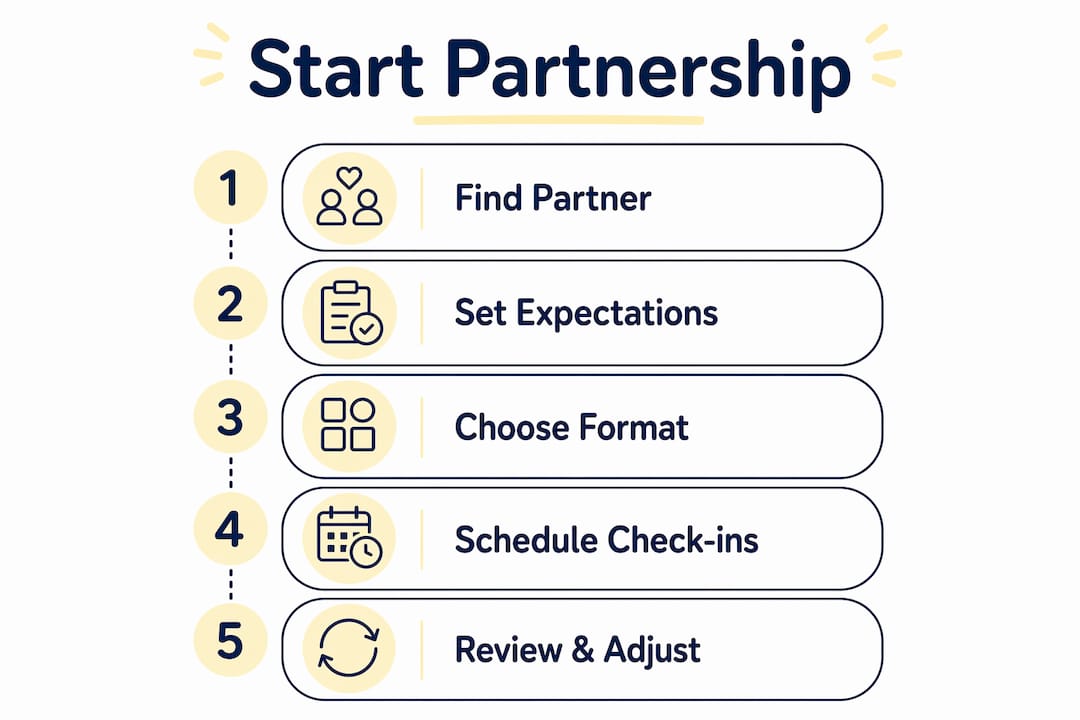
Pro Tip: Start with one check-in format for four weeks before adding another. Layering too many structures at once overwhelms the system and makes it harder to identify what is actually working.
What are the biggest challenges and how do you fix them?
Even a well-designed ADHD accountability group or partnership will hit friction. Knowing the common pitfalls in advance means you can respond with curiosity instead of defeat.
The most damaging pattern is when check-ins start to feel like performance reviews. When you dread your check-in because you did not complete your tasks, the partnership has shifted from support to supervision. Accountability partners should support, not supervise. The fix is simple: reframe every check-in as a problem-solving conversation, not a progress report.
A second common challenge is dependency. Some people with ADHD find they cannot work at all without their partner present. This is a signal to widen your support toolkit rather than deepen reliance on one person. Clinicians recommend combining partnerships with therapy, medication, and environmental design rather than treating any single tool as the whole solution.
Here are the most effective strategies for keeping your partnership healthy over time:
- Use the 48-hour cool-off rule. When a new project or idea excites you, wait 48 hours before bringing it into your accountability structure. This boundary prevents impulsive goal-switching that derails both partners.
- Separate social time from work time. If you and your partner are also friends, keep the friendship and the accountability structure in separate conversations. Mixing them creates emotional burnout.
- Pivot after three failed attempts. If you have tried changing the time, format, and task type three times without progress, that signals a mismatch, not a willpower problem. Try a different partner or a different structure entirely.
"The question is never 'why can't you just do it?' The question is always 'what would make it easier to start?'" This reframe is the foundation of every effective ADHD accountability strategy.
How do you build a full ADHD support toolkit around your partnership?
An ADHD accountability partnership works best as one layer in a broader support system, not as a standalone fix. Understanding the ADHD brain's neurophysiology helps explain why external accountability is so effective: the dopamine regulation system that drives motivation and task initiation works differently in ADHD brains. External structures compensate for what internal motivation cannot reliably provide.
Internal accountability alone is unreliable for ADHD. Tools like UpOrbit provide externalized reminders and commitment tracking that keep goals visible between check-ins. Visibility is accountability. When your goals live only in your head, they fade. When they live in a shared system, they persist.
The table below shows how different support tools complement an accountability partnership:
| Support Tool | Primary Function | Works Best When |
|---|---|---|
| Accountability partner | Goal tracking and check-ins | Goals are specific and check-ins are consistent |
| ADHD coaching | Executive function skill building | You need strategy, not just support |
| Medication | Neurological regulation | Prescribed and monitored by a clinician |
| Environmental design | Reducing friction and distraction | Your workspace is reorganized intentionally |
| Virtual co-working (UpOrbit, ADDA) | Presence-based focus support | You need company without conversation |
Joining an ADHD accountability group adds another layer. Groups like ADDA Turbo Tuesdays offer peer-led sessions that combine body doubling with light social accountability. The group format also reduces the pressure on any single partnership. When your one-on-one partner is unavailable, the group is still there.
Recognize when to seek professional ADHD coaching. If your partnership consistently stalls on the same type of task, a coach can identify the executive function skill gap underneath the behavior. Partnerships support action. Coaches build capacity.
Self-compassion built into your accountability system reduces procrastination by lowering the emotional cost of getting back on track after a lapse. The easier you make it to re-engage, the more often you will.
Key takeaways
An ADHD accountability partnership succeeds when it combines clear structure, curiosity-based communication, and integration with a broader support system rather than functioning as a standalone fix.
| Point | Details |
|---|---|
| Choose a neutral partner | Avoid family or romantic partners; peers or community members maintain better neutrality. |
| Name the first physical action | Specifying the exact first step reduces executive function load and improves task initiation. |
| Use curiosity-based check-ins | Ask "what got in the way?" instead of "why didn't you do it?" to prevent shame cycles. |
| Pivot after three failed attempts | If time, format, and task type changes all fail, the issue is mismatch, not willpower. |
| Integrate with broader tools | Combine your partnership with medication, coaching, and apps like UpOrbit for lasting results. |
What i have learned from years of watching these partnerships work and fail
The partnerships I have seen succeed share one quality that no checklist captures: patience with the process. Not patience as passive waiting, but patience as an active choice to stay curious when things go sideways. The people who give up on ADHD accountability usually do so after one or two rough check-ins, convinced the system does not work for them. What they have actually discovered is that one version of the system does not work. That is useful information, not failure.
The single change that transformed the most struggling partnerships I have observed was the shift to naming first physical actions. It sounds almost too simple. "Open the laptop." "Click the document." But for an ADHD brain staring down a task that feels like a wall, that level of specificity is the difference between starting and spiraling. The wall does not disappear. You just find the door.
I also want to say something that most guides skip: it is okay if your first accountability partner is not the right fit. It does not mean you are too difficult to support. It means you learned something about what you need. Treat every partnership attempt as data, not as a verdict on your ability to change.
The kindest thing you can do for yourself when you start this process is to build forgiveness into the structure before you need it. You will need it. That is not pessimism. That is how ADHD works, and designing around reality is always smarter than pretending it away.
— Jason
Build your ADHD support community with Adhdawearness
Starting an accountability partnership is one of the most practical steps you can take toward managing ADHD with confidence. Adhdawearness exists to support that kind of real, grounded progress.
At Adhdawearness, you will find educational content, community connections, and bold apparel that turns everyday moments into conversations about ADHD awareness. Every purchase from the ADHD awareness store supports ADHD-focused nonprofits, so your wardrobe becomes part of something larger. Whether you are just starting your accountability journey or deepening an existing support system, Adhdawearness gives you the community and the tools to keep going. You do not have to figure this out alone.
FAQ
What is an ADHD accountability partner?
An ADHD accountability partner is someone who helps you track goals and follow through on commitments through regular, structured check-ins. Unlike body doubling, which relies on silent presence, an accountability partner actively engages with your progress and asks questions to keep you on track.
How do i find an ADHD accountability partner?
The best places to find an ADHD accountability partner include ADHD community groups like ADDA, online forums, and apps like UpOrbit that match users for accountability purposes. Avoid choosing close family members or romantic partners, as existing emotional dynamics often reduce effectiveness.
How often should ADHD accountability check-ins happen?
Check-in frequency depends on your goals and schedule, but most effective partnerships use daily text check-ins for habit building or weekly video calls for deeper goal reviews. Sessions typically run 15–75 minutes depending on the format you choose.
What should you do when an ADHD accountability partnership stops working?
If changing the time, format, and task type three times produces no improvement, the partnership likely signals a mismatch rather than a motivation problem. Try a new partner, a different structure, or add a community group like ADDA Turbo Tuesdays for additional support.
Can an ADHD accountability partnership replace therapy or medication?
An accountability partnership complements therapy and medication but does not replace either. Clinicians recommend using partnerships as one tool within a broader ADHD management system that includes professional support and environmental design.