
TL;DR:
- Children with ADHD face social rejection and internalized stigma that harm their self-esteem and social skills. Schools and families can reduce stigma through education, support, and open communication, improving mental health and inclusion outcomes. Addressing stigma directly creates a more accepting environment essential for children's well-being and development.
ADHD stigma impact on children is defined as the social and psychological harm children experience when others treat their diagnosis as a character flaw rather than a neurological condition. This stigma lowers self-esteem, weakens social skills, and delays access to treatment. Research published in 2026 confirms that children with ADHD face measurably higher rates of peer rejection and internalizing problems like anxiety and depression. Schools and families are the two environments where stigma either takes root or gets interrupted. Understanding how this works gives you real power to protect the children in your life.
How does ADHD stigma affect children's social skills and peer relationships?
ADHD stigma directly damages children's ability to form and keep friendships. Children with ADHD score significantly lower on social skills assessments than their peers, with total social skills scores averaging 178.16 for the ADHD group compared to 199.66 for controls. That gap is not just a number. It reflects real daily struggles: difficulty reading social cues, interrupting conversations, and missing unspoken rules that other children pick up naturally.

Peer rejection compounds the problem. When a child is already working harder to fit in, stigma adds another layer of pressure. Classmates who have absorbed negative stereotypes about ADHD are more likely to exclude or bully children with the diagnosis. This creates a cycle where social skill challenges invite rejection, and rejection deepens those challenges further.
The distinction between social skill deficits and stigma-driven exclusion matters for how you respond. A child who struggles with turn-taking needs skill-building support. A child who is deliberately left out because peers have labeled them "weird" or "crazy" needs an environment where those attitudes are actively challenged. Both problems are real, and both require different responses.
| Measure | Children with ADHD | Children without ADHD |
|---|---|---|
| Total social skills score | 178.16 | 199.66 |
| Peer victimization risk | Significantly higher | Lower |
| Self-esteem levels | Lower | Higher |
- Children with ADHD are more likely to be bullied than to bully others.
- Social rejection reinforces negative self-perception over time.
- Friendships, even one strong one, buffer against the worst effects of exclusion.
- Stigma from peers often reflects attitudes absorbed from adults.
Pro Tip: If a child with ADHD tells you they have "no friends," treat it as a clinical signal, not a passing complaint. Early social isolation predicts worse mental health outcomes in adolescence.
In what ways does stigma impact mental health and treatment for children with ADHD?
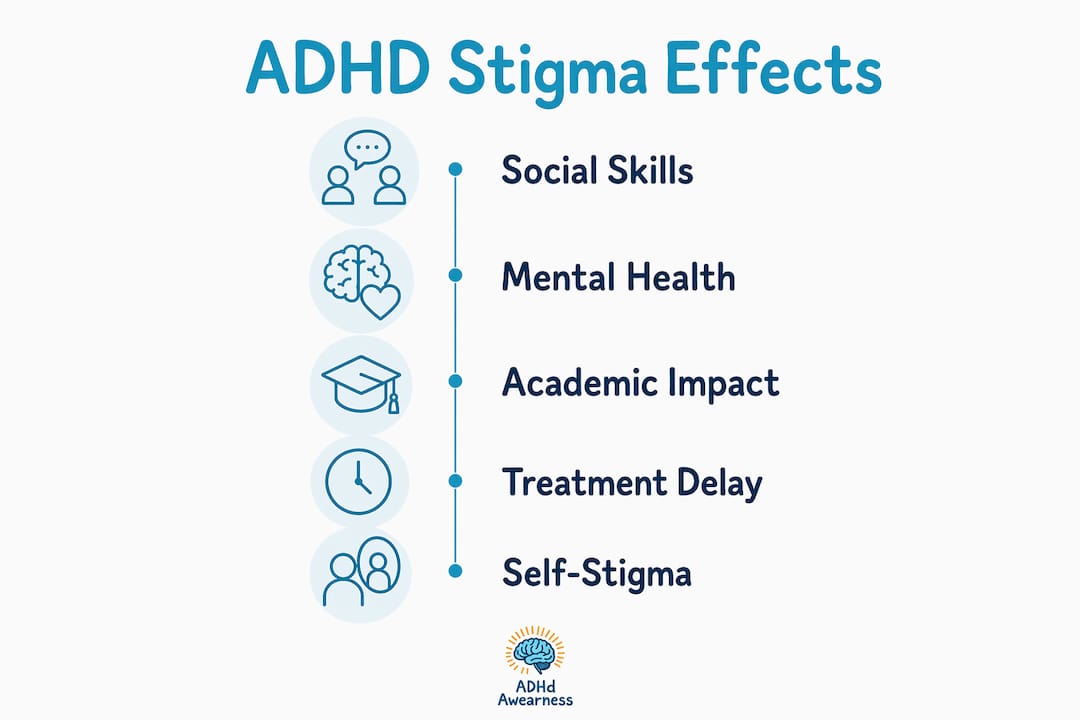
Stigma is a direct barrier to diagnosis and treatment. Children and families who fear judgment delay seeking help, and that delay worsens outcomes. ADHD stigma causes delayed treatment access, restricted social participation, and increased risk of depression and anxiety. The longer a child goes without support, the more their self-concept forms around failure rather than difference.
Internalized stigma, sometimes called self-stigma, is the process by which a child absorbs society's negative messages and turns them inward. A child who hears "you just need to try harder" enough times starts to believe the problem is their character, not their neurology. Self-stigma links directly to lower self-esteem, increased depression, and poorer mental health across the board. This is what makes ADHD internalized stigma so damaging. It is invisible to most adults, but it shapes how a child sees their future.
The masking paradox makes this worse. Many children with ADHD learn to hide their symptoms to avoid judgment. Masking can look like success on the surface, but excessive masking results in emotional exhaustion and reduced well-being. A child who spends every school day suppressing their natural responses is burning through mental energy that should go toward learning and connection. By the time they get home, they often fall apart, and parents are left wondering why.
Self-esteem and parental mental health are the two strongest mediators between ADHD symptoms and internalizing problems. Research confirms that these two factors have the most impact on whether a child develops anxiety or depression alongside their ADHD. That finding puts parents directly in the equation. Your own stress and self-blame affect your child's outcomes in measurable ways.
- Watch for sudden withdrawal from activities the child previously enjoyed.
- Persistent complaints of stomachaches or headaches before school can signal stigma-related anxiety.
- A child who stops talking about school friends may be experiencing social exclusion.
- Resistance to taking medication in front of peers is a common sign of stigma-driven shame.
Pro Tip: Ask your child "What do you think your classmates believe about ADHD?" rather than "Are you being bullied?" The indirect question surfaces stigma-related fears that children rarely volunteer.
What role do schools and educators play in reducing ADHD stigma?
Schools are the primary site where public stigma toward ADHD forms. Children spend more waking hours at school than anywhere else, and the attitudes they absorb there shape how they see themselves and their peers for years. School climate and connectedness significantly reduce ADHD-related stigma, especially concerns about public attitudes. A school where belonging is actively built is a school where stigma has less room to grow.
Teacher attitudes carry outsized weight. When a teacher frames ADHD as laziness or a discipline problem, the entire class absorbs that message. When a teacher responds to a distracted child with patience and structure, peers notice that too. Educators who redirect ADHD students without drawing attention to their differences model the kind of acceptance that changes classroom culture over time.
Contact-based education is the most effective anti-stigma intervention in school settings. A three-element approach combining contact, protest, and education reduces ADHD stigma more effectively than information alone. Lectures about what ADHD is do less than structured interactions where students work alongside peers with ADHD and see them as full people.
Here are four practical steps educators can take right now:
- Normalize neurodiversity in classroom language. Avoid phrases like "settle down" directed only at children with ADHD. Use universal language that frames different learning styles as expected, not exceptional.
- Build peer support structures. Assign collaborative tasks that let children with ADHD contribute their strengths. Peer support at school is significantly associated with lower stigma concern in children with ADHD.
- Train staff on stigma, not just symptoms. Professional development that addresses attitude change, not just accommodation strategies, produces lasting shifts in school climate.
- Create safe reporting channels. Children who experience stigma-driven bullying need a way to report it without fear of further exclusion.
Pro Tip: Invite a parent or young adult with ADHD to speak to your class. First-person contact reduces stigma faster than any curriculum alone.
How can parents and educators support children against ADHD stigma?
Creating a safe disclosure environment is the foundation of every other support strategy. Children with ADHD face a genuine dilemma: they want peers and teachers to understand them, but they fear rejection if they share their diagnosis. Selective sharing of diagnosis is a coping strategy, not dishonesty. Your job is to help children feel in control of their own story.
Knowing how to explain an ADHD diagnosis to your child in age-appropriate, strength-based language is the first step. Children who understand their own neurology are better equipped to respond to stigma when they encounter it. They can say "my brain works differently" instead of absorbing the message that they are broken.
Active parental involvement in mental health support produces measurable improvements. This does not mean hovering. It means staying connected, asking open questions, and seeking professional support early when signs of anxiety or depression appear. Healthy friendship environments buffer against social exclusion and bullying. Facilitating even one strong peer relationship, through structured playdates, shared interest groups, or community activities, can change a child's social trajectory.
- Validate your child's frustration without catastrophizing. "That sounds really hard" is more useful than "I'll call the school tomorrow."
- Connect with parent support groups to reduce your own isolation. Your mental health directly affects your child's.
- Advocate for your child's accommodations without framing them as special treatment. Language matters.
- Teach children the difference between privacy and secrecy. They do not owe anyone their diagnosis, but hiding it out of shame is different from choosing when and with whom to share.
Pro Tip: Role-play disclosure conversations at home. Practice gives children language and confidence for real situations, which reduces the anxiety that stigma thrives on.
Why stigma is the problem we keep misidentifying
I have spent years watching families and schools focus almost entirely on managing ADHD behavior while the stigma underneath goes unaddressed. The child gets a behavior plan. The classroom gets a seating chart. Nobody asks what the child believes about themselves because of how others have treated them.
The research is clear: relational approaches outperform symptom management alone. A child who feels genuinely understood by at least one adult at school has a fundamentally different experience than a child who is merely accommodated. Accommodation without belonging is not enough. It tells a child their needs are tolerated, not that they belong.
What I find most underestimated is the cumulative weight of small stigmatizing moments. A sigh from a teacher. A joke from a classmate. A parent who whispers the diagnosis like it is something shameful. None of these feel catastrophic in isolation. Together, they build a story a child tells themselves about who they are and what they deserve.
The families I have seen navigate this best are the ones who treat ADHD as a conversation, not a secret. They talk about it at the dinner table. They read about it together. They wear their understanding openly. That kind of family culture does not eliminate stigma, but it gives children the internal resources to resist it.
— Bruce
ADHD Awearness: resources for families and educators
Stigma does not shrink on its own. It shrinks when people talk about ADHD openly, accurately, and without shame. ADHD Awearness exists to make that easier for families and educators who want to do more than just cope.

At ADHD Awearness, you will find blogs, videos, and podcasts built for real conversations about ADHD stigma, diagnosis, and daily life. The site also offers 100% USA-made apparel designed to spark exactly the kind of conversations that reduce stigma in schools and communities. A portion of every sale supports ADHD-focused nonprofits. If you want to carry the message further, the Abilities Collection is a good place to start. Wearing awareness is one of the simplest ways to signal to a child with ADHD that they are seen and valued.
FAQ
What is ADHD internalized stigma in children?
ADHD internalized stigma, also called self-stigma, is when a child absorbs society's negative beliefs about ADHD and applies them to themselves. It leads to lower self-esteem, increased depression, and reduced willingness to seek help.
How does ADHD stigma harm students academically?
Stigma increases anxiety and social withdrawal, both of which reduce a child's ability to focus and engage in school. Children who fear judgment for their ADHD symptoms are less likely to ask for help, which compounds academic difficulties over time.
Why does an ADHD diagnosis sometimes relieve family guilt?
A diagnosis replaces blame with explanation. Parents who spent years wondering what they did wrong often feel significant relief when they understand that ADHD is neurological, not the result of poor parenting or a child's bad choices.
What is the masking paradox in ADHD?
Masking is when a child hides ADHD symptoms to avoid stigma. While it can reduce immediate social friction, excessive masking causes emotional exhaustion and worsens mental health over time.
How can schools reduce ADHD stigma effectively?
Schools reduce stigma most effectively through contact-based education, strong peer support structures, and positive school connectedness. Research shows that higher school connectedness directly correlates with lower stigma levels in children with ADHD.