
TL;DR:
- Explaining ADHD to children involves using age-appropriate metaphors and focusing on their strengths.
- Parents should frame the diagnosis as something their child has, not as their identity, to protect self-esteem.
Attention-Deficit/Hyperactivity Disorder, or ADHD, is a neurodevelopmental condition that affects how the brain manages attention, impulses, and activity levels. When you need to explain an ADHD diagnosis to your child, the goal is simple: help them understand their brain without making them feel broken or different in a bad way. The right words, delivered at the right time, can shift the entire experience from scary to clarifying. This guide gives you a step-by-step approach, age-appropriate language, and practical tools to make that conversation feel natural and supportive.
How do you start the conversation about ADHD with your child?
The best place to start is with your child's own experience, not the label. CHADD advises parents to avoid saying "You are ADHD" and instead frame it as something the child has. That one shift separates your child's identity from the diagnosis and protects their self-esteem from the very first sentence.

Before you explain anything, ask what your child already knows or feels. Happiful recommends starting with curiosity prompts and tailoring your language to what the child already understands. You might ask, "Have you ever noticed that your brain feels really busy sometimes?" or "Do you ever feel like it's hard to slow down?" These questions open the door without putting your child on the defensive.
Listen more than you talk in the first conversation. Your child may already have a name for what they feel. They may say things like "my brain won't stop" or "I can't make myself do it even when I want to." Those phrases are gold. They tell you exactly where to anchor your explanation so it lands as recognition, not a verdict.
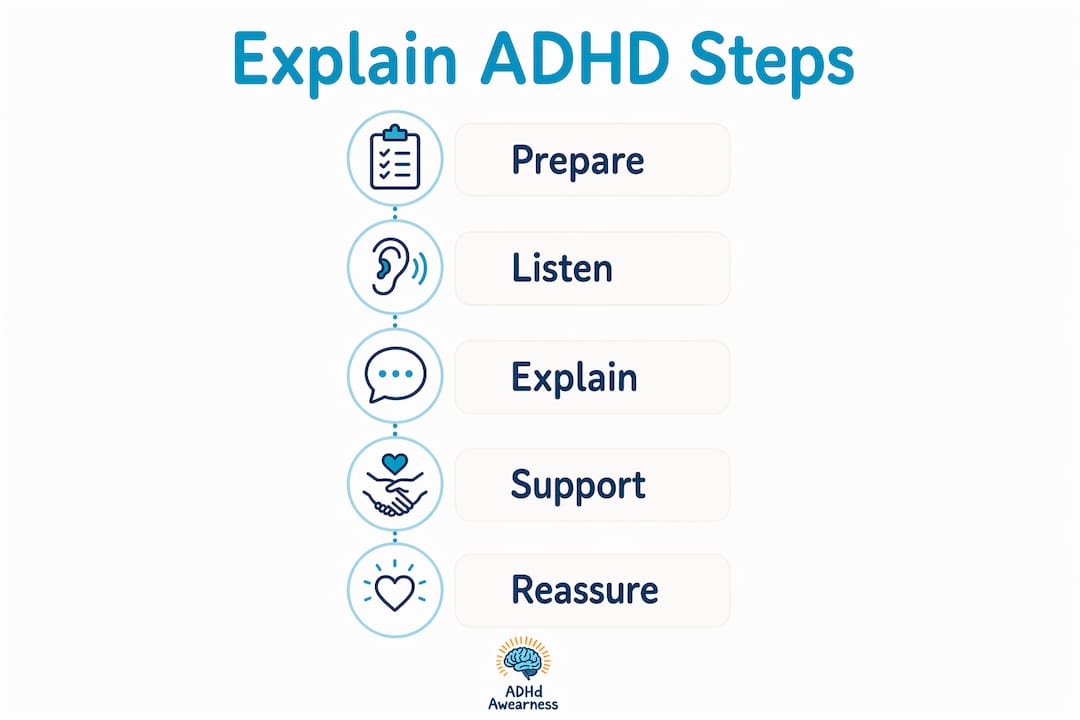
Here are four steps to guide the opening conversation:
- Ask first. Find out what your child already thinks or feels about their brain or behavior.
- Validate their experience. Say something like, "That makes total sense. A lot of kids feel that way."
- Introduce the idea gently. Tell them the doctor has a name for why their brain works the way it does.
- Invite questions. Let them lead the pace. Not every child wants all the information at once.
Pro Tip: Keep the first conversation short. Ten minutes of honest, calm dialogue does more good than a long lecture. You can always come back to it.
What are age-appropriate ways to explain ADHD brain differences?
ADHD is a difference in how the brain regulates attention, impulses, and activity. That is the core fact. The way you explain it depends entirely on your child's age and how they process information.
For children ages 5–8, concrete metaphors work best. Monarch Assessment provides age-segmented scripts that use the "race car brain" metaphor. The idea is simple: your child's brain is like a race car with a super-powerful engine, but the brakes need a little extra help. That framing is honest, non-shaming, and actually exciting for a young child. It says "your brain is powerful" before it says "your brain needs support."
For children ages 9–12, you can add a layer of neuroscience without overwhelming them. Explain that the brain has a part called the prefrontal cortex that acts like the brain's manager. In kids with ADHD, that manager is still developing and sometimes sends messages a little slower than in other kids. That is not a flaw. It is just how their brain is wired right now, and there are tools that help.
For teenagers, honesty and respect go further than metaphors. Teens want to understand the actual science. You can explain that ADHD involves differences in dopamine regulation, which affects motivation, focus, and impulse control. Pair that with the fact that many people with ADHD show strong creativity, high energy, and the ability to hyperfocus on things they love. That balance matters.
Here is a quick comparison of how to frame ADHD across age groups:
| Age Group | Best Framing | Example Language |
|---|---|---|
| Ages 5–8 | Race car brain metaphor | "Your brain is super fast and powerful." |
| Ages 9–12 | Brain manager explanation | "The part that helps you pause is still growing." |
| Ages 13+ | Dopamine and science | "ADHD affects how your brain uses dopamine." |
One thing stays constant across every age: ADHD is not laziness, bad behavior, or a parenting failure. Yale Medicine describes ADHD as a condition related to how the brain is wired, not how hard a child tries. Saying that clearly and often protects your child from internalizing shame.
Pro Tip: Avoid the word "problem" when describing ADHD. Use "difference" instead. Language shapes how children see themselves.
How can you explain the ADHD diagnosis process to your child?
Children often feel like the diagnosis came out of nowhere. Explaining how it happened reduces that sense of mystery and helps them trust the outcome. Cigna explains that an ADHD assessment collects information from teachers, family members, and medical providers. That multi-source process is actually reassuring to children when you frame it correctly.
Tell your child something like: "A lot of people who know you really well all shared what they noticed. Your teacher, our family, and the doctor all put their pieces together to get the full picture of how your brain works." That framing makes the diagnosis feel thorough and fair, not arbitrary or punishing.
Here is what the assessment typically involves, broken down in child-friendly terms:
- Questionnaires from teachers. The people who see your child every day at school share what they observe.
- Information from parents. You described what you notice at home, during homework, and in social situations.
- A conversation with the doctor. The specialist asked questions and may have done some activities with your child directly.
- Putting it all together. All of that information creates a complete picture of how your child's brain works best.
The key message is this: the diagnosis is not a punishment. It is a map. It shows where your child needs extra support and where they already shine.
| What was collected | Why it matters |
|---|---|
| Teacher observations | Shows how the brain works in structured settings |
| Parent input | Captures behavior at home and in daily life |
| Medical evaluation | Rules out other causes and confirms the pattern |
| Child's own responses | Gives the child a voice in their own story |
How do you link the ADHD diagnosis to practical support and strengths?
Explaining the diagnosis without connecting it to real support leaves children feeling labeled but not helped. Monarch Assessment shows that framing ADHD with associated tools, like movement breaks and reminders, helps children accept the diagnosis and cooperate with support plans. The diagnosis becomes a door, not a wall.
Start by naming the tools in plain language. Movement breaks give the race car brain a chance to reset. Reminders and checklists act like the brain's external manager when the internal one needs backup. Timers help make abstract time feel real. These are not crutches. They are the same kind of support that glasses give to someone who needs them to see clearly.
The NHS recommends involving school teams and using inclusive language and consistent praise. That means the conversation does not stop at home. Your child's teacher, school counselor, and support staff all become part of the same team. When your child hears the same strengths-based language from every adult around them, it sticks.
Here are practical supports to introduce alongside the diagnosis explanation:
- Movement breaks. Short physical activity resets focus and reduces frustration.
- Visual reminders. Sticky notes, checklists, and picture schedules reduce cognitive load.
- Timers. A visible countdown makes transitions and task-switching less jarring.
- Quiet workspaces. Reducing sensory input helps the brain focus on one thing at a time.
- Praise for effort. Recognizing the attempt, not just the result, builds resilience.
Equally important is naming your child's strengths out loud and often. Many children with ADHD show exceptional creativity, strong empathy, and the ability to hyperfocus on topics they love. You can read more about how the ADHD brain functions to understand why those strengths are real and neurologically grounded.
Pro Tip: Ask your child to name three things they are really good at right after you talk about supports. It anchors the conversation in their strengths, not their struggles.
What I have learned from watching families have this conversation
The families who handle this best are the ones who treat the diagnosis as the beginning of a conversation, not the end of one. The Pediatric Neurodevelopmental Center recommends unfolding diagnosis talks over time, following the child's cues rather than delivering everything at once. That advice matches what I have seen work in practice.
The single biggest mistake parents make is trying to resolve everything in one sitting. Your child will have new questions next week, next month, and next year. Their understanding of ADHD will grow as they grow. Your job is not to explain it perfectly once. Your job is to stay available and honest every time a new question surfaces.
Separating the diagnosis from your child's identity is the most protective thing you can do. A child who hears "you have ADHD" processes that very differently than a child who hears "you are ADHD." The first framing leaves room for growth, strengths, and a full sense of self. The second collapses identity into a diagnosis, and that is where shame takes root.
Celebrate small wins loudly and often. When your child uses a timer successfully, names their own need for a break, or asks for help before melting down, that is a win. Those moments show the diagnosis is working as a tool, not a label. If you are looking for community support while navigating these conversations, the ADHD support groups for parents guide at ADHD Awearness is a good place to connect with others walking the same road.
— Jason
ADHD Awearness: resources for families building understanding
ADHD Awearness was built for exactly this moment. When you are trying to explain a diagnosis, find the right words, and help your child feel proud of how their brain works, having the right community around you makes a real difference.

ADHD Awearness offers educational content, including blogs, videos, and podcasts, designed to help parents and children understand ADHD without shame. The Abilities Collection features USA-made apparel that carries a strengths-based message your child can wear and own. A portion of every sale supports ADHD-focused nonprofits, so your purchase does something beyond your household. Visit ADHD Awearness to find resources, community, and products that reinforce the message your child needs to hear.
FAQ
What is the best way to explain ADHD to a young child?
Use a simple metaphor like the "race car brain," where the engine is powerful but the brakes need extra help. Monarch Assessment recommends age-segmented scripts that emphasize strengths and pair the explanation with practical supports.
Should I tell my child they have ADHD?
Yes. CHADD advises that children benefit from knowing their diagnosis when it is framed as something they have, not something they are. Withholding the diagnosis often leads to more confusion and self-blame.
How do I explain the ADHD diagnosis process to my child?
Tell your child that their teachers, family, and doctor all shared what they noticed so everyone could understand how their brain works best. Cigna explains that this multi-source process makes the diagnosis thorough and fair, which reassures children it was not arbitrary.
How often should I talk to my child about their ADHD?
The diagnosis conversation is ongoing, not a single event. The Pediatric Neurodevelopmental Center recommends following your child's cues and returning to the topic as new questions arise at different stages of development.
Does ADHD mean my child will struggle in school?
ADHD affects how the brain manages attention and impulses, but it does not determine academic potential. With the right supports, including movement breaks, reminders, and strengths-based teaching, children with ADHD can thrive. The NHS recommends involving school teams early to build a consistent support plan.