
TL;DR:
- Respectful redirection helps ADHD students refocus privately without disrupting the class. Teachers who respond to over half of disruptive behaviors see fewer rule violations over time. Proper environmental setup, movement breaks, and clear instructions support smoother classroom management.
Redirecting an ADHD student without disrupting class means using brief, private, and immediate cues that refocus the student while keeping the rest of the room on track. The industry term for this is respectful redirection, and it is one of the most researched behavioral strategies in special education. Teachers who apply it consistently see real results. Responding to over 50% of disruptive behaviors produces a measurable reduction in future rule violations. That threshold matters because it tells you consistency is the engine, not intensity.

How to redirect an ADHD student without disrupting class
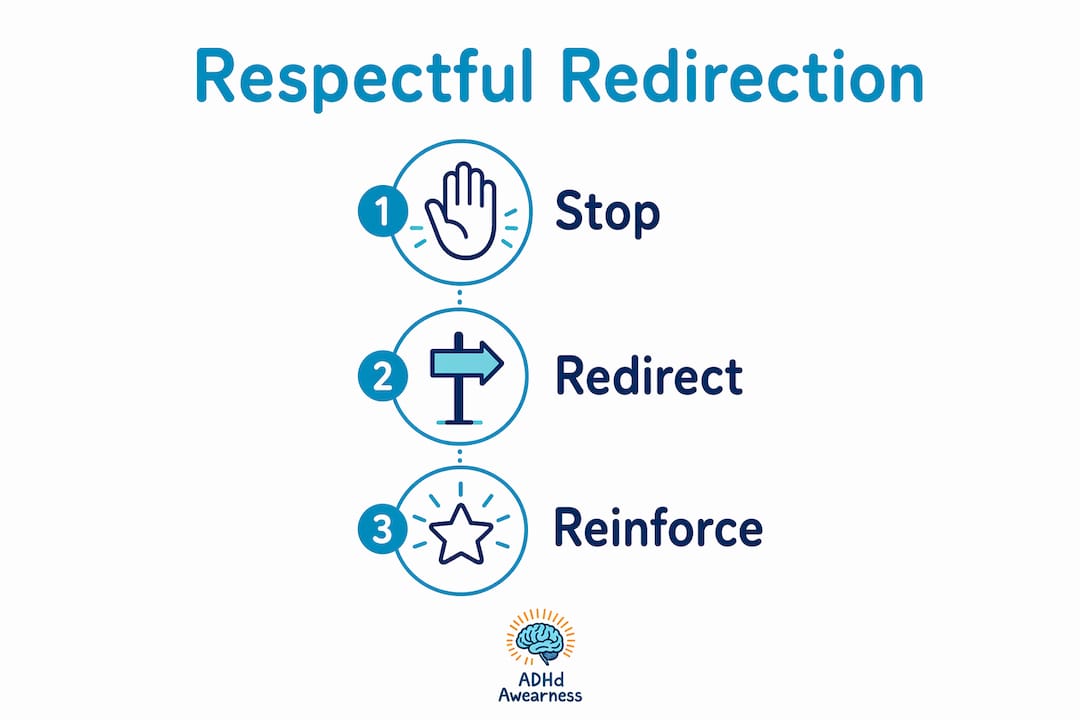
Respectful redirection is defined as brief, neutral, instructional feedback delivered privately to refocus a student without drawing the class's attention. It is not a reprimand. It is not a lecture. It is a quick course correction, like a quiet hand on a steering wheel.
The method follows three steps: stop the behavior privately, direct an alternative behavior, and reinforce with specific praise. Immediate, private redirection outperforms public correction for ADHD students because public reprimands increase emotional distress and reduce the student's capacity to self-regulate. When a student feels called out in front of peers, their nervous system shifts into defense mode. Learning stops.
ADHD behavior is communication, not defiance. A student tapping a pencil, turning around in their seat, or calling out an answer is not trying to derail your lesson. Their brain is seeking stimulation because the dopamine regulation system works differently. Viewing behavior as communication rather than a discipline problem changes how you respond and how the student receives that response.
Common mistakes teachers make include giving long verbal explanations mid-lesson, repeating corrections publicly, or waiting until frustration builds before acting. All three escalate the situation. The most effective cues are short and calm.
Here are practical verbal and nonverbal redirection cues you can use right now:
- Proximity: Walk toward the student and stand nearby without saying a word. Physical presence alone often refocuses attention.
- Nonverbal signal: Establish a private hand signal or tap on the desk with the student beforehand. Use it as a pre-agreed cue.
- Quiet verbal prompt: Crouch down and say in a low voice, "I need your eyes on the board. You can do this."
- Redirect to task: Place a sticky note on the student's desk with the current step written on it, then move on.
- Planned ignoring: For mild attention-seeking behavior that does not disrupt others, planned ignoring avoids reinforcing the behavior with negative attention.
Pro Tip: Agree on a private signal with your ADHD student at the start of the year. A simple two-finger tap on their shoulder means "refocus." This removes the need for any verbal correction during instruction.
Do movement breaks and flexible seating actually reduce disruptions?
Yes, and the research is specific. Movement breaks of 3 to 5 minutes every 20 to 30 minutes help regulate the ADHD nervous system and reduce disruptive behavior. That window matters because ADHD students typically reach their attention ceiling well before neurotypical peers. Waiting 45 minutes for a natural break is too long.
Practical movement break ideas that work in a regular classroom include:
- A quick stretch sequence led by a student volunteer
- Passing out materials or collecting papers (task-based movement)
- A 60-second "brain break" where students stand and do jumping jacks or shake out their hands
- Transitioning to a new activity at a standing table or whiteboard
Flexible seating is equally effective. Wobble stools, standing desks, and resistance bands attached to chair legs give ADHD students a physical outlet without leaving their seat. The key is normalizing these tools for the whole class. When every student has access to a wobble stool, no one is singled out. That removes the social stigma that often makes ADHD students resist using sensory supports.
Addressing environmental triggers like poor transition timing and crowded seating prevents disruptive behavior more reliably than repeated corrections after the fact. Think of the classroom environment as your first line of support, not an afterthought.
Pro Tip: Forcing stillness is counterproductive for ADHD students. If a student is rocking slightly or fidgeting with a quiet object and staying on task, that movement is regulation, not disruption. Let it be.
How do chunked instructions and positive reinforcement work together?
Breaking directions into smaller steps is one of the most direct ways to reduce confusion and keep ADHD students on task. Chunked directions reduce overwhelm by presenting one manageable piece of information at a time rather than a multi-step sequence the working memory cannot hold.
Here is how to apply chunking in real classroom moments:
- Give one direction at a time. Instead of "Open your book to page 42, read the first paragraph, and answer questions 1 through 3," say "Open your book to page 42." Pause. Confirm. Then give the next step.
- Write steps on the board. Visual anchors reduce the cognitive load of holding verbal instructions in working memory.
- Check for understanding privately. After giving a direction, walk to the ADHD student and quietly confirm they know what to do next.
- Use specific praise immediately after compliance. Say "You opened your book right away. That's exactly what I needed." Vague praise like "Good job" does not register the same way.
- Pair praise with corrective feedback. Think of it like bumpers in bowling. Positive praise combined with corrective feedback guides students toward success more reliably than correction alone.
Delayed feedback reduces the chance of positive behavior change for ADHD students. Their brains need the connection between action and response to happen quickly. Waiting until the end of the day to praise a morning behavior is too late for the feedback loop to stick.
What classroom setup minimizes distractions and supports smooth redirection?
The physical environment does a significant amount of behavioral work before you say a single word. Environmental modifications like preferential seating and visual cues support sustained attention and reduce the frequency of redirection needed.
The table below compares seating and environmental strategies by their primary benefit:
| Strategy | Primary benefit | Best used when |
|---|---|---|
| Seat near teacher | Quick nonverbal access | Student needs frequent check-ins |
| Seat off-center, away from windows | Fewer visual distractions | Student is easily pulled off task by movement |
| Seat near a calm peer | Positive behavior modeling | Student responds to social cues |
| Visual schedule posted at desk | Reduces transition anxiety | Student struggles with routine changes |
| Private nonverbal signal system | Redirects without interrupting class | Student is sensitive to public correction |
Visual schedules and transition warnings are particularly effective for managing ADHD impulsivity in the classroom. A two-minute warning before an activity change gives the ADHD brain time to shift gears. Without it, transitions become flashpoints for disruptive behavior.
Private nonverbal cues like standing nearby or making brief eye contact redirect ADHD students without interrupting instruction for anyone else. These cues work best when established in advance, so the student knows what they mean and does not feel ambushed.
Calm, consistent routines reduce the overall need for correction. When students know exactly what comes next, their nervous systems stay regulated. Predictability is not boring for ADHD students. It is protective.
What I've learned from watching teachers redirect ADHD students well
The teachers who do this best share one quality: they are not trying to stop the behavior. They are trying to understand it. That shift in mindset changes everything about how redirection lands.
I have seen teachers spend enormous energy on public corrections that escalate the very behavior they want to stop. The student feels humiliated. The class gets distracted. The teacher feels frustrated. Everyone loses. The teachers who get results are the ones who treat every behavioral moment as information, not a personal challenge to their authority.
Fidgeting is a perfect example. Movement and fidgeting are often regulatory strategies for ADHD students, not acts of defiance. Interrupting a student who is quietly tapping their foot and staying on task is unnecessary. Save your redirection for moments that genuinely disrupt learning.
The other thing I would tell any teacher is this: you will not get it right every time. Some days a student will need five redirections before lunch. That is not failure. That is ADHD. The goal is to build a system that makes those moments shorter, calmer, and less visible to the rest of the class. Empathy and consistency, applied together over time, produce the results that no single technique can deliver alone.
For teachers who want to go deeper, the ADHD Awearness science resources offer research-backed reading that connects classroom strategies to the neuroscience behind them.
— Jason
How ADHD Awearness supports educators like you
Managing ADHD in class takes more than good intentions. It takes community, knowledge, and tools that remind both teachers and students that neurodiversity is a strength.

ADHD Awearness exists to make that support real. The site offers blogs, videos, and podcasts built for educators, parents, and individuals navigating ADHD every day. Every purchase from the ADHD Awearness store supports ADHD-focused nonprofits, because awareness should do more than sit on a shelf. The Abilities Collection is especially popular in school communities, sparking conversations about neurodiversity in hallways and classrooms alike. Visit ADHD Awearness to explore resources, connect with a community, and carry the message forward.
FAQ
What is respectful redirection for ADHD students?
Respectful redirection is a three-step behavioral strategy: stop the behavior privately, direct an alternative behavior, and reinforce with specific praise. It keeps class flow intact while supporting the student without public correction.
Why do ADHD students disrupt class in the first place?
ADHD students disrupt class because their brains seek stimulation to regulate dopamine levels, not because they intend to cause problems. Behavior is communication, and understanding that shifts how teachers respond.
How often should teachers redirect ADHD students?
Responding to over 50% of disruptive behaviors produces a measurable reduction in future rule violations. Consistency matters more than the intensity of any single correction.
Do movement breaks really help with ADHD behavior in class?
Yes. Movement breaks of 3 to 5 minutes every 20 to 30 minutes help regulate the ADHD nervous system and reduce disruptive behavior. Scheduled breaks work better than reactive ones.
What is the fastest nonverbal way to redirect an ADHD student?
Standing near the student or using a pre-agreed private signal, like a two-finger tap on the shoulder, redirects attention without interrupting instruction for the rest of the class.