
TL;DR:
- ADHD identity involves integrating a diagnosis into how individuals perceive themselves and relate to others. It evolves through stages of rejection, acceptance, engulfment, and enrichment, affecting mental health and self-esteem. Social communities and language choices influence how people develop and express their ADHD identity.
ADHD identity is defined as the personal and social process of integrating an ADHD diagnosis into your core sense of self, shaping how you see yourself and how you move through the world. This is distinct from the clinical diagnosis itself. The DSM-5-TR identifies ADHD as a neurodevelopmental disorder, but what happens after that label lands is a deeply human, psychological process. Researchers use the term "illness identity" to describe the four ways people relate to a chronic condition: rejection, acceptance, engulfment, and enrichment. Understanding ADHD and self-identity matters because it directly affects your mental health, your relationships, and your ability to build a life that actually fits your brain. This article walks through the research, the terminology debates, the social forces at play, and the practical steps toward building an ADHD identity that feels true to you.
What is ADHD identity and how does it shape self-perception?
ADHD identity is the ongoing process of deciding what your diagnosis means about who you are. It is not a fixed destination. It shifts as you age, as your circumstances change, and as you encounter new communities and challenges.

The psychological framework most researchers use is the illness identity model, which describes four identity stages: rejection, acceptance, engulfment, and enrichment. Each stage reflects a different relationship between you and your diagnosis. Rejection means you push the label away entirely. Acceptance means you acknowledge ADHD without letting it define you. Engulfment means the diagnosis consumes your self-concept. Enrichment means you see ADHD as a source of meaning, creativity, or community.
These stages are not a straight line. Identity stages are fluid, and people cycle through them repeatedly as life transitions occur. A person who reaches enrichment in their twenties may slide back into rejection after a career setback or a difficult relationship. That is not failure. It is how identity actually works.
A 2026 study of 500 college students found that those meeting DSM-5-TR criteria for ADHD reported higher imposter phenomenon, greater identity distress, and lower self-esteem than peers without ADHD. That finding matters because it shows the emotional weight of ADHD identity is real and measurable, not just a personal sensitivity.
How do people experience and relate to ADHD identity differently?
No two people land in the same place with their ADHD identity. Symptom severity, self-esteem, life history, and social environment all shape how someone relates to their diagnosis.
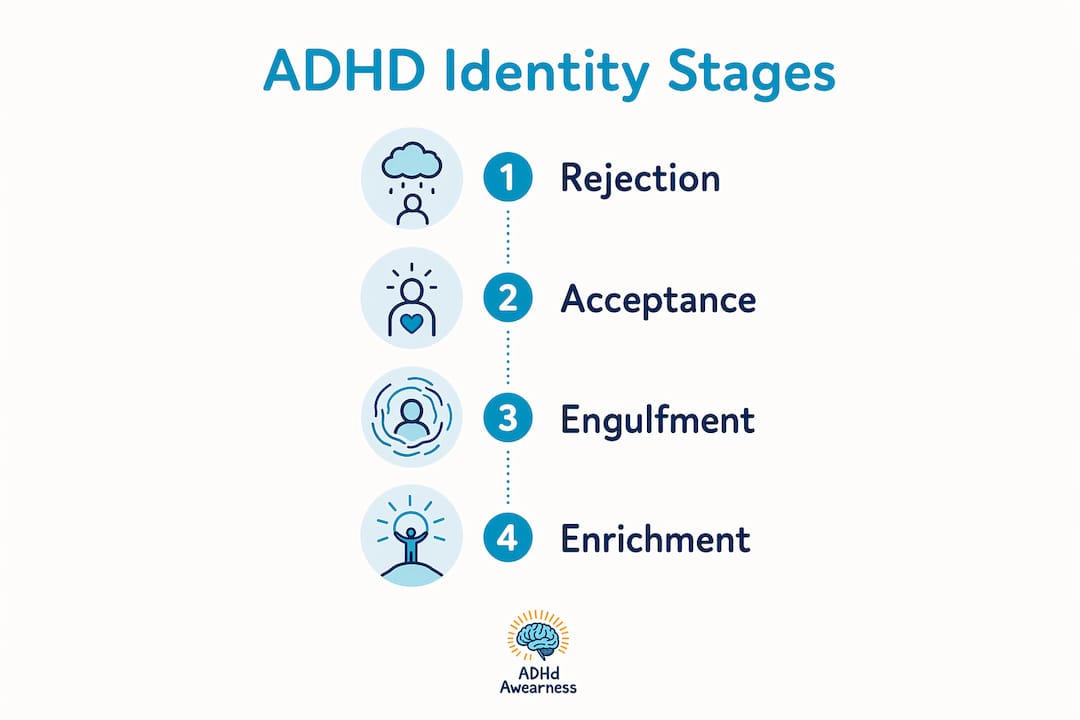
People in the rejection stage often describe their ADHD as a medical inconvenience rather than a part of who they are. They may resist accommodations or avoid ADHD communities because they do not want the label to follow them. People in the engulfment stage go the other direction. Every struggle gets filtered through ADHD, and the diagnosis becomes the primary explanation for everything. Neither extreme tends to support long-term wellbeing.
The enrichment stage is where most people find the most stability. Here, ADHD becomes one thread in a larger identity rather than the whole fabric. Research shows this stage correlates with better quality of life and stronger self-esteem.
Key factors that influence which stage someone occupies include:
- Symptom severity: More severe symptoms often push people toward engulfment or rejection, especially without adequate support.
- Self-esteem: Low self-esteem makes it harder to integrate ADHD without shame.
- Community connection: Access to affirming peers accelerates movement toward acceptance and enrichment.
- Life transitions: New jobs, relationships, or diagnoses can shift your position in the identity framework.
Pro Tip: If you notice your ADHD identity feels overwhelming right now, that is a signal to look at what life stressor is active, not a sign that you have regressed permanently.
What terminology do people use to describe ADHD identity?
The words people choose to describe their ADHD reveal a great deal about how central the diagnosis is to their self-concept. Two main frameworks exist: person-first language and identity-first language.
Person-first language places the individual before the diagnosis. "I am a person with ADHD" separates the person from the condition. Identity-first language does the opposite. "I am ADHD" or "I am an ADHDer" treats the neurological difference as a core part of who someone is, not something external they carry.
| Language style | Example phrase | Common preference |
|---|---|---|
| Person-first | "A person with ADHD" | General adult population |
| Identity-first | "I am ADHD" or "ADHDer" | ADHD-focused online communities |
77% of UK adults with ADHD prefer person-first terminology, while identity-first language is more common among those active in ADHD-focused online communities. That split reflects something real: the more central ADHD is to your social world, the more likely you are to fold it into your core identity label.
Terminology choice signals identity centrality and community engagement, without a universal right or wrong answer. Your preference can also change over time. Someone who starts with person-first language may shift toward identity-first as they deepen their connection to neurodivergent communities, and that shift is healthy, not inconsistent.
Pro Tip: Ask the ADHD people in your life which language they prefer before assuming. Getting it right builds trust faster than any explanation.
What role do social factors and communities play in shaping ADHD identity?
ADHD identity does not form in isolation. The communities you belong to, the social media you consume, and the intersecting parts of your identity all shape how you understand your diagnosis.
Online ADHD communities offer something many people never received before diagnosis: validation. Seeing others describe your exact experience, often with humor and specificity, can accelerate the move from rejection toward acceptance. Online ADHD communities can validate identity formation, but they can also create pressure to perform a particular version of ADHD that may not match your actual experience.
ADHD intersectionality adds another layer. Age, race, gender, and socioeconomic status all influence how ADHD identity develops and how it is received by others. A Black woman diagnosed in adulthood faces a different social context than a white boy diagnosed at age seven. Late diagnosis, which is more common among women and people of color due to historical research gaps, often means years of self-blame that must be unraveled before identity integration can begin. Understanding ADHD intersectionality means recognizing that no single ADHD experience represents everyone.
A 2025 study of 740 neurodivergent adults found that endorsement of a shared neurodivergent identity is modest overall, with co-occurring Autism and ADHD individuals showing stronger alignment with a collective neurodivergent identity than those with ADHD alone. That finding suggests the neurodivergent umbrella resonates differently depending on your specific neurological profile.
"Balancing online community validation against individual offline self-exploration is critical to forming a healthy ADHD identity that supports mental health and personal growth."
The risks of heavy community involvement include comparison and pressure to fit an "ADHD aesthetic," where certain traits get celebrated while others are minimized. If you find yourself performing ADHD for an audience rather than exploring it for yourself, that is worth noticing. Many people who feel misunderstood as ADHD adults describe this exact tension between community belonging and authentic self-expression.
How can someone embrace and rebuild their ADHD identity after diagnosis?
Many adults describe their diagnosis as both a relief and a crisis. The relief comes from finally having an explanation. The crisis comes from realizing that much of what you thought was your personality was actually a set of coping strategies built to survive in a neurotypical world.
Unmasking ADHD identity involves dismantling those neurotypical coping behaviors, a process that often brings grief alongside freedom. You may grieve the years spent struggling without support, the relationships strained by misunderstood behavior, or the version of yourself you thought you were supposed to be. That grief is legitimate and worth honoring.
Rebuilding looks different for everyone, but research and clinical practice point to a consistent process:
- Acknowledge the diagnosis as a starting point, not an ending. Diagnosis is a gateway to deeper personal exploration, not the final word on who you are.
- Identify what was masking and what is genuinely you. Some traits you suppressed are worth reclaiming. Others were never yours to begin with.
- Design your environment around your neurology. ADHD identity is about congruence: aligning your life around how your brain actually functions rather than forcing it to perform neurotypical productivity.
- Seek professional support. A therapist familiar with ADHD can help you separate shame from self-knowledge. This is not optional for many people. It is the difference between cycling through rejection and reaching genuine acceptance.
- Connect with peer communities intentionally. Choose communities that celebrate the full range of ADHD experience, not just the parts that photograph well. Resources like support in ADHD adult life can help you find the right fit.
The goal is not to become a different person. The goal is to stop spending energy pretending to be someone you are not. That energy, redirected, is where ADHD strengths tend to show up most clearly.
Pro Tip: Write down three things you stopped doing because they felt "too ADHD." Then ask yourself which of those things you actually want back. That list is a map toward your authentic identity.
ADHD identity is never finished, and that is actually the point
I have spent years thinking about what it means to build an identity around a brain that works differently. What I keep coming back to is this: the people who struggle most with ADHD identity are the ones who want it to be settled. They want to reach enrichment and stay there. But identity does not work that way for anyone, let alone for people whose brains are wired for novelty and change.
The most grounded ADHD people I have encountered hold their identity loosely. They know ADHD shapes how they think, work, and relate to others. But they do not let it be the only story they tell about themselves. They resist the pull toward engulfment without sliding into denial. That balance is not a personality trait. It is a practice.
The terminology debate, person-first versus identity-first, is real and worth taking seriously. But I think the more useful question is: does the language you use about yourself make you feel more capable, or does it shrink you? If "I am ADHD" feels like a homecoming, use it. If "I have ADHD" gives you room to breathe, use that. Neither is a moral position. Both are tools.
What I would push back on is the idea that any community, online or offline, gets to define your ADHD identity for you. Communities can offer mirrors. They cannot tell you what you see.
— Jason
ADHD Awearness: resources for your identity journey
ADHD Awearness exists for exactly this kind of moment, when you are trying to figure out what your diagnosis actually means for your life.
Through educational blogs, podcasts, and videos, ADHD Awearness gives you research-backed content that respects your intelligence and your experience. The ADHD Awearness store carries 100% USA-made apparel designed to spark real conversations about neurodiversity, with a portion of every sale supporting ADHD-focused nonprofits. Whether you are newly diagnosed or years into your self-understanding, wearing your neurodivergent identity can be a quiet act of advocacy. Visit ADHD Awearness to find community, education, and gear that reflects who you actually are.
FAQ
What is ADHD identity in simple terms?
ADHD identity is the process of integrating your ADHD diagnosis into your sense of self, shaping how you see yourself and how you relate to others. It goes beyond clinical symptoms to include personal meaning, community belonging, and self-concept.
What are the four stages of ADHD illness identity?
The four stages are rejection, acceptance, engulfment, and enrichment. These stages are non-linear, meaning people cycle through them at different points in life rather than moving through them in a fixed order.
Is identity-first or person-first language better for ADHD?
Neither is universally better. Research shows 77% of UK adults with ADHD prefer person-first language, while identity-first language is more common in ADHD-focused online communities. The right choice is whichever feels most authentic to you.
How does intersectionality affect ADHD identity?
Factors like race, gender, age, and socioeconomic status shape how ADHD identity develops and how it is received socially. Late diagnosis, which is more common among women and people of color, often requires additional identity work to undo years of self-blame.
Can online ADHD communities help with identity formation?
Yes, but with limits. Online communities provide validation and shared experience, which accelerates identity acceptance. They can also create pressure to perform a specific version of ADHD, so balancing community involvement with personal offline reflection produces the healthiest outcomes.