
TL;DR:
- ADHD combined type involves meeting the full diagnostic criteria for both inattentive and hyperactive-impulsive symptoms. It is the most frequently diagnosed presentation in children and adults, with symptoms that can change over time.
ADHD combined type is defined as a presentation in which a child meets the full diagnostic criteria for both inattentive and hyperactive-impulsive symptoms simultaneously. It is the most frequently diagnosed ADHD presentation in children and adults alike. The DSM-5, updated through 2026, uses the term "presentation" rather than "subtype" to reflect how symptoms can shift across a lifetime. Understanding ADHD combined type explained in clear terms gives you, as a caregiver, a more accurate picture of what your child is experiencing and why targeted support matters so much.
What are the core symptoms and diagnostic criteria for ADHD combined type?
The DSM-5 requires children under 17 to show 6 or more symptoms from both the inattentive and hyperactive-impulsive categories to qualify for a combined type diagnosis. Those symptoms must persist for at least 6 months and appear in more than one setting, such as home and school. Adults aged 17 and older need to meet a threshold of 5 or more symptoms from each category. That lower adult threshold reflects how some symptoms naturally reduce in visibility with age, even when the underlying neurology remains the same.
Inattentive symptoms commonly seen in children
These are the quieter symptoms. They do not always look like a problem from across the room, but they create real friction in daily learning and relationships.
- Frequently loses track of instructions mid-task
- Struggles to sustain attention during homework or reading
- Avoids tasks that require extended mental effort
- Makes careless mistakes on schoolwork despite trying
- Forgets daily routines, such as packing a backpack or completing chores
- Appears to not listen when spoken to directly
Hyperactive-impulsive symptoms commonly seen in children
These are the more visible symptoms. They are often what first prompts a teacher or pediatrician to raise the possibility of ADHD.
- Leaves seat at inappropriate times in class
- Runs or climbs in situations where it is not appropriate
- Talks excessively or blurts out answers before questions are finished
- Has difficulty waiting for a turn
- Interrupts or intrudes on others' conversations or games
- Fidgets constantly with hands, feet, or objects
Pro Tip: Ask your child's teacher to document specific behaviors across different times of day. ADHD symptoms often intensify during unstructured periods or late afternoon, and that pattern is clinically meaningful.
The DSM-5's shift to "presentation" language is not just semantic. It signals that symptom profiles are fluid, meaning a child diagnosed with combined type today may present differently at age 16. Keeping that in mind prevents caregivers from locking into a fixed idea of what their child's ADHD looks like.
| Symptom Category | Minimum Symptoms (Under 17) | Minimum Symptoms (17 and Older) | Duration Required |
|---|---|---|---|
| Inattentive | 6+ | 5+ | 6 months |
| Hyperactive-Impulsive | 6+ | 5+ | 6 months |
| Combined (both) | 6+ each | 5+ each | 6 months |
How does ADHD combined type compare to other ADHD presentations?
The DSM-5 recognizes three ADHD presentations: predominantly inattentive, predominantly hyperactive-impulsive, and combined. Each has a distinct symptom profile, though they share the same underlying neurology. Understanding the differences helps caregivers recognize why combined type often creates more wide-ranging challenges than either presentation alone.
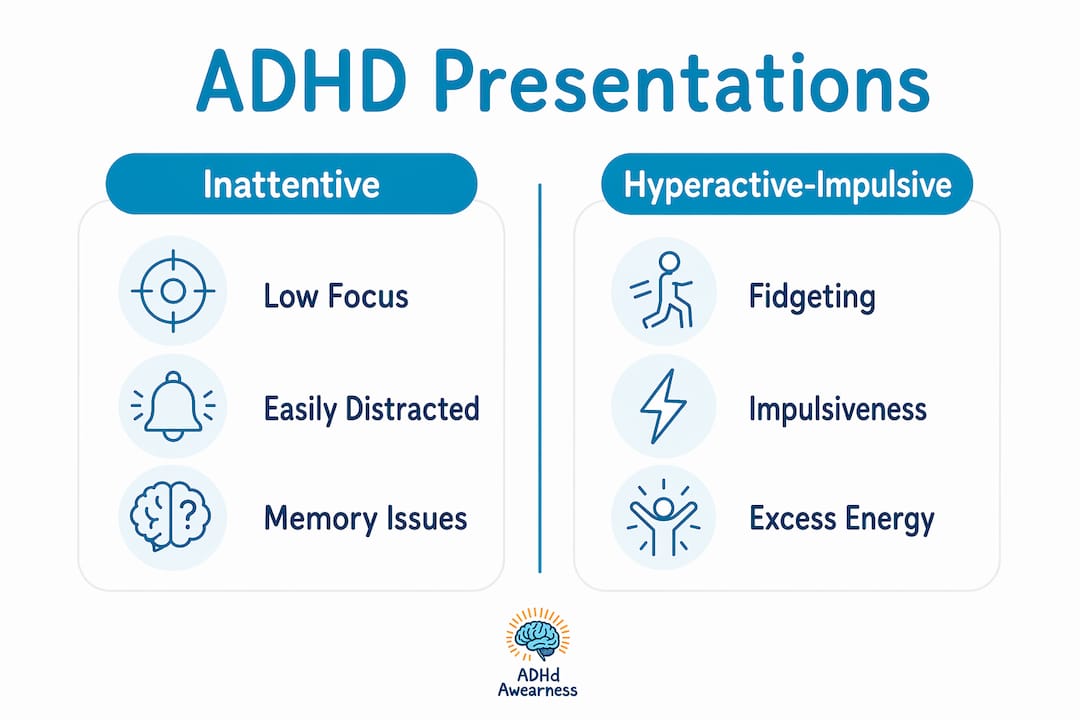
Predominantly inattentive presentation, sometimes still informally called ADD, involves meeting the symptom threshold only for inattention. These children are often described as quietly inattentive, daydreamy, or slow to complete work. They rarely disrupt a classroom, which is exactly why they are frequently missed or diagnosed later. Predominantly hyperactive-impulsive presentation involves meeting the threshold only for hyperactivity and impulsivity. This is more common in younger children and often becomes less prominent as the child grows.
| Presentation | Inattentive Symptoms | Hyperactive-Impulsive Symptoms | Most Common Age of Diagnosis |
|---|---|---|---|
| Predominantly Inattentive | 6+ (or 5+ adults) | Below threshold | School age, often later |
| Predominantly Hyperactive-Impulsive | Below threshold | 6+ (or 5+ adults) | Preschool to early school age |
| Combined | 6+ (or 5+ adults) | 6+ (or 5+ adults) | School age |
Combined type carries challenges from both domains at once. A child who cannot focus and also cannot sit still faces compounding difficulties in a standard classroom. The combined label describes challenges across two neurological domains: attention regulation and impulse control. That dual burden is why combined type tends to produce more noticeable academic and social difficulties than either presentation in isolation.
What is the prevalence and demographic profile of children with ADHD combined type?
Combined type is the most common ADHD presentation. Among adults with an ADHD diagnosis, about 60% fit the combined presentation profile. That figure reflects how many people carry both symptom clusters into adulthood, even when hyperactivity becomes less physically obvious over time.
Gender patterns in ADHD diagnosis have shifted considerably. Historical estimates placed the boy-to-girl ratio at roughly 9:1. Current research puts that ratio closer to 2:1. That shift reflects better clinical recognition of how ADHD presents in girls, not a sudden change in biology.
Girls with combined type ADHD are more likely to internalize hyperactivity as racing thoughts or emotional dysregulation rather than physical restlessness. They are also more likely to develop compensatory behaviors that mask inattentive symptoms, such as working twice as hard to appear organized. Those masking strategies delay diagnosis and allow years of unnecessary struggle to accumulate. Caregivers of daughters should be especially alert to signs of chronic exhaustion, anxiety, or low self-esteem alongside any attention difficulties.
A few key demographic patterns worth knowing:
- Boys are still diagnosed more frequently, but the gap is narrowing as clinicians improve screening tools for girls
- Symptoms in younger children tend to include more visible hyperactivity, while older children and teens show more inattentive features
- Combined type can coexist with anxiety, learning disabilities, or sleep disorders, all of which require separate evaluation
The CDC notes that ADHD symptoms overlap with other conditions, making comprehensive evaluation by a qualified healthcare provider non-negotiable for an accurate diagnosis.
What challenges do children with ADHD combined type face, and how can caregivers help?
Children with combined type ADHD face a specific pattern of difficulty that goes beyond simple distractibility or energy. The core problem is neurological regulation. The brain's systems for filtering information, managing impulses, and sustaining effort do not work in the same way they do for neurotypical children. That is not a character flaw. It is a physiological reality.

Executive function is where the impact shows up most clearly. Executive function refers to the brain's management system: planning, organizing, starting tasks, and regulating emotions. Children with combined type often struggle to initiate homework even when they understand the material. They may lose track of multi-step instructions not because they were not listening, but because working memory does not hold information long enough for them to act on it.
The most damaging misinterpretation caregivers and teachers make is labeling these behaviors as laziness or defiance. Unfinished tasks in children with combined type result from physiological regulation issues, not lack of effort or willingness. Reframing that interpretation changes everything about how you respond to your child.
Practical support strategies that make a real difference include:
- Structured routines: Predictable daily schedules reduce the cognitive load of deciding what comes next, freeing up mental energy for the task itself
- Environmental adjustments: Reducing visual clutter, background noise, and digital distractions in homework spaces lowers the competition for attention
- Chunked tasks: Breaking assignments into smaller steps with clear stopping points helps children initiate and complete work without becoming overwhelmed
- Positive reinforcement: Specific, immediate praise for effort (not just outcome) builds the motivation loop that ADHD brains need more of
- Collaborative communication: Asking "what would help you get started?" rather than "why haven't you started?" shifts the dynamic from confrontation to problem-solving
Pro Tip: Effective treatment for combined type ADHD often requires a combination of stimulant medication, behavioral skill-building, and family support. Talk to your child's pediatrician or a child psychiatrist about a tailored treatment plan that addresses both symptom clusters.
Viewing ADHD combined type as a neurological condition rather than a behavioral choice is the single most powerful shift a caregiver can make. It replaces frustration with curiosity and punishment with problem-solving.
What I've learned from watching caregivers navigate this diagnosis
The families who make the most progress with a combined type diagnosis are not the ones who found the perfect medication or the best school program first. They are the ones who changed how they interpreted their child's behavior before anything else changed.
I have seen caregivers arrive at a diagnosis feeling relieved and then, within months, feel just as lost because the label did not come with a manual. The DSM-5's shift to "presentation" language is genuinely useful here. It reminds you that your child is not a fixed category. Symptoms evolve as the brain develops, and the support strategies that work at age 8 may need to be rebuilt at age 13.
The other thing I would tell any caregiver is this: your education matters as much as your child's treatment. When you understand why your child interrupts, loses things, or cannot start homework, you stop taking it personally. That shift in your own emotional response creates a calmer environment, and calmer environments genuinely reduce symptom severity. Community matters too. Connecting with other caregivers through parent support groups gives you real-world strategies that no clinical pamphlet provides. You are not meant to figure this out alone.
— Jason
ADHD Awearness: community and resources for caregivers
ADHD Awearness was built for exactly this moment in your caregiving experience. When the diagnosis is fresh and the questions keep coming, having a community that gets it makes a real difference.

ADHD Awearness offers educational content, including blogs, videos, and podcasts, designed to help families understand ADHD clearly and without stigma. Every purchase from the ADHD Awearness store supports ADHD-focused nonprofits, and the apparel itself starts conversations that reduce stigma in everyday life. The Abilities Collection is a strong starting point for caregivers who want to carry a message of understanding into their community. Visit ADHD Awearness to connect with resources built specifically for families like yours.
FAQ
What is ADHD combined type?
ADHD combined type is a DSM-5 diagnosis in which a child meets the full symptom threshold for both inattentive and hyperactive-impulsive presentations. It is the most common ADHD presentation in both children and adults.
How many symptoms are required for a combined type diagnosis?
Children under 17 must show 6 or more symptoms from both the inattentive and hyperactive-impulsive categories, persisting for at least 6 months across multiple settings. Adults aged 17 and older need 5 or more symptoms from each category.
Is ADHD combined type the same as having two separate ADHD diagnoses?
No. Combined type is a single diagnosis that reflects symptom presence across two neurological domains: attention regulation and impulse control. It is one presentation, not two conditions stacked together.
Can ADHD combined type change over time?
Yes. The DSM-5 uses the term "presentation" rather than "subtype" specifically because symptoms shift across a lifetime. A child diagnosed with combined type may show a predominantly inattentive profile in adolescence as hyperactivity becomes less visible.
Why are girls with combined type ADHD diagnosed later than boys?
Girls are more likely to internalize hyperactivity as emotional dysregulation or racing thoughts rather than physical restlessness, and they more often develop masking behaviors that hide inattentive symptoms. The gender diagnosis ratio has shifted from a historical 9:1 to approximately 2:1 boys to girls as clinicians improve recognition of these patterns.