
TL;DR:
- Inattentive ADHD is a quiet, internal presentation of the disorder characterized by persistent inattention and executive function difficulties. It often goes unnoticed because its symptoms are subtle and not disruptive, leading to late or missed diagnoses, especially in females and adults. Supporting individuals with inattentive ADHD involves environmental adjustments, behavioral strategies, medication, and early recognition to improve outcomes.
Attention deficit disorder inattentive type is a presentation of ADHD defined by persistent difficulty sustaining attention, following through on tasks, and managing executive function, without the hyperactivity or impulsivity that most people associate with ADHD. Clinically, it is recognized in the DSM-5 as ADHD, Predominantly Inattentive Presentation. Because the symptoms are quiet and internal rather than disruptive, this type is frequently missed by teachers, pediatricians, and even parents who are watching for a child who can't sit still. Understanding what it actually looks like, and why it matters, is the first step toward getting the right support.
What are the key symptoms of attention deficit disorder inattentive type?
The DSM-5 identifies nine core inattentive symptoms used to diagnose this presentation of ADHD. Recognizing them in real life, rather than on a checklist, is where parents and educators make the biggest difference.
The nine symptoms are:
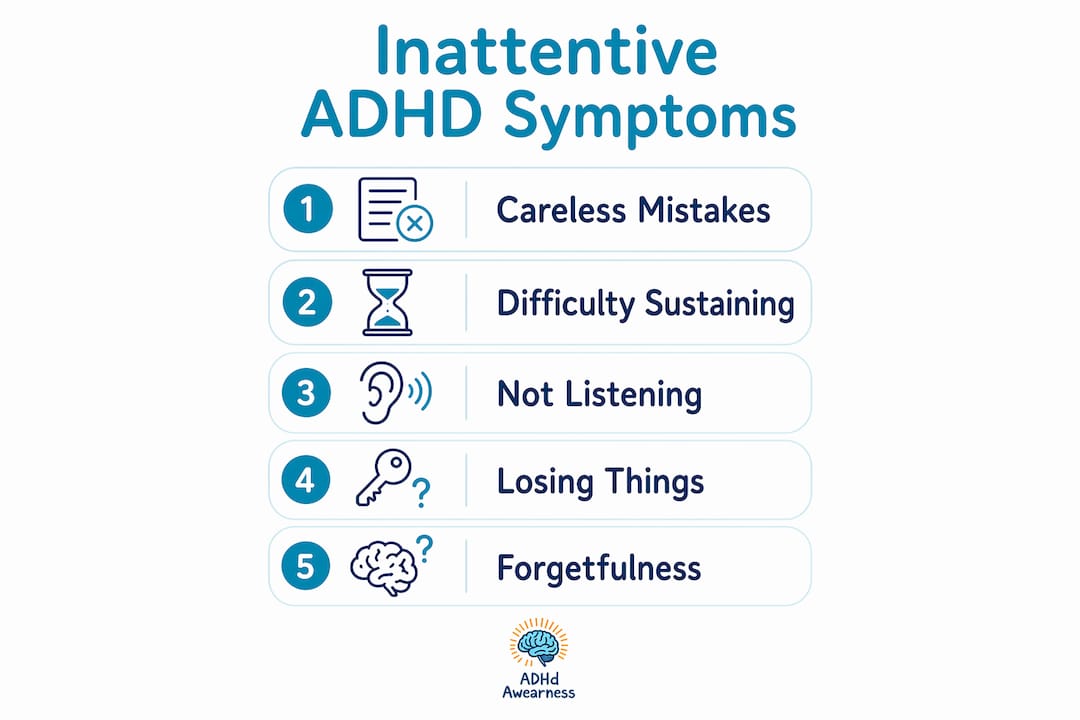
- Failing to give close attention to details or making careless mistakes in schoolwork or other activities
- Difficulty sustaining attention during tasks or play
- Seeming not to listen when spoken to directly
- Not following through on instructions and failing to finish schoolwork or chores
- Difficulty organizing tasks and activities
- Avoiding or being reluctant to engage in tasks that require sustained mental effort
- Losing things necessary for tasks (pencils, homework, keys)
- Being easily distracted by unrelated stimuli
- Being forgetful in daily activities
For a formal diagnosis, children need 6 or more of these symptoms, while adults 17 and older need only 5. Symptoms must persist for at least 6 months and appear in two or more settings, such as home and school. That cross-setting requirement matters because every child has an off day. What clinicians are looking for is a consistent pattern that genuinely interferes with functioning.
Symptoms also look different depending on age. A 7-year-old might lose her homework three times a week and stare out the window during reading. A 16-year-old might seem capable but consistently turn in incomplete assignments. An adult with inattentive type ADHD in adults might miss deadlines, forget appointments, and feel chronically overwhelmed by ordinary responsibilities.

Pro Tip: Watch for the child who is always "almost done" but never quite finishes. Task completion, not just task starting, is one of the most telling signs of inattentive ADHD in classroom settings.
How does inattentive ADHD differ from other ADHD types?
The three recognized ADHD presentations are Predominantly Inattentive, Predominantly Hyperactive-Impulsive, and Combined. Understanding the differences helps parents and educators avoid misreading a child's behavior.
| Feature | Inattentive type | Hyperactive-impulsive type | Combined type |
|---|---|---|---|
| Primary symptoms | Attention, organization, memory | Fidgeting, interrupting, impulsivity | Both sets of symptoms |
| Classroom behavior | Quiet, withdrawn, daydreaming | Disruptive, out of seat, talkative | Variable |
| Diagnosis timing | Often late, especially in girls | Usually earlier due to visibility | Moderate |
| Risk of being missed | High | Low | Moderate |
The inattentive presentation is frequently misdiagnosed or recognized late, particularly in females and adults. A quiet girl who sits at her desk and daydreams does not trigger the same concern as a boy who disrupts the class. She gets labeled as shy, spacey, or unmotivated. He gets referred for evaluation. That gap in recognition has real consequences for how long people wait to get help.
One of the most persistent myths about inattentive ADHD is that it reflects laziness or a lack of motivation. It does not. Inattentive ADHD is a neurobiological deficit in executive function, rooted in how the brain regulates dopamine and norepinephrine. The prefrontal cortex, which manages planning, attention, and impulse control, does not function the same way in an ADHD brain. You can read more about the underlying science in this ADHD brain function guide from ADHD Awearness.
Another nuance worth knowing: ADHD presentations shift with age. Hyperactivity often decreases during adolescence, which means a child who was previously diagnosed with combined or hyperactive-impulsive ADHD may appear predominantly inattentive by adulthood. This is not recovery. It is a natural evolution of how the condition expresses itself.
One more phenomenon that confuses people is hyperfocus. Individuals with inattentive ADHD can concentrate intensely on stimulating tasks while being completely unable to sustain attention on routine ones. A child who can play video games for three hours but cannot read a textbook for ten minutes is not choosing to be difficult. The brain responds to stimulation, and low-stimulation tasks simply do not generate enough dopamine to sustain focus.
Pro Tip: If a student performs well in hands-on or creative subjects but consistently struggles with repetitive or reading-heavy tasks, that pattern is worth flagging. It is a hallmark of inattentive ADHD, not inconsistent effort.
What challenges do people with inattentive ADHD face daily?
The daily experience of inattentive ADHD goes well beyond forgetting where you put your phone. Time blindness and task paralysis are two of the most disabling features, and neither shows up on a standard symptom checklist in plain language.
Time blindness means the brain does not register the passage of time the way a neurotypical brain does. A student genuinely cannot feel that 45 minutes have passed. Task paralysis means that even when a person knows exactly what they need to do, they cannot initiate the task. It is not procrastination in the ordinary sense. It is a neurological block between intention and action.
Here is what that looks like in practice:
- A high school student knows her essay is due tomorrow. She sits at her desk for two hours, opens her laptop, and writes one sentence. She is not distracted by her phone. She simply cannot start.
- An adult with ADHD inattentive type misses a bill payment for the third month in a row, not because he forgot it existed, but because the mental steps required to log in, navigate the site, and complete the transaction felt insurmountable.
- A child loses his permission slip three times before the field trip. His backpack is a chaos of papers he cannot organize, not because he does not care, but because his brain does not automatically sort and prioritize information.
Academic performance suffers in ways that look like underachievement. Social-emotional health takes a hit too. Children with undiagnosed inattentive ADHD often internalize the message that they are not smart enough or not trying hard enough. That narrative, repeated over years, contributes to anxiety and depression. Comorbid anxiety or depression frequently masks the underlying ADHD, leading clinicians to treat the secondary condition while the root cause goes unaddressed.
What strategies actually support people with inattentive type ADHD?
Effective support for inattentive ADHD combines behavioral strategies, environmental changes, and, in many cases, medication. No single approach works for everyone, but the evidence points clearly toward a few core principles.
-
Build external structure. The inattentive brain struggles to create internal order, so the environment has to do that work. Use visual timers like Time Timer, color-coded planners, and checklists posted at eye level. These are not accommodations that make things easier. They are tools that make the brain's job possible.
-
Use executive function coaching. Executive function coaching, offered by specialists trained through organizations like the ADHD Coaches Organization (ACO), teaches concrete skills for planning, prioritizing, and managing time. This is different from tutoring. It targets the underlying process deficits, not just the academic content.
-
Consider medication as part of a comprehensive plan. Stimulant medications like methylphenidate (Ritalin, Concerta) and amphetamine salts (Adderall, Vyvanse) are the most studied treatments for ADHD and show strong effectiveness for inattentive presentations. Non-stimulant options like atomoxetine (Strattera) and viloxazine (Qelbree) work for individuals who cannot tolerate stimulants. Medication decisions should always involve a qualified clinician.
-
Advocate for school accommodations. Under the Individuals with Disabilities Education Act (IDEA) and Section 504 of the Rehabilitation Act, students with ADHD qualify for formal accommodations. Extended time on tests, preferential seating, reduced-distraction testing environments, and assignment chunking are all evidence-based supports.
-
Address mental health alongside ADHD. Anxiety and depression are common companions to inattentive ADHD. Treating comorbid conditions without addressing the core executive dysfunction leads to incomplete care. A good treatment plan accounts for the whole person, not just the most visible symptoms.
Pro Tip: Audiobooks and audio-based learning tools can be genuinely useful for students with inattentive ADHD who struggle to sustain focus while reading. Resources like audiobooks for ADHD offer practical alternatives that work with the brain rather than against it.
Why the "quiet" label is the most dangerous one
I have spent years watching the same story unfold. A bright kid, usually a girl, sits quietly in class and gets overlooked. Her teachers describe her as dreamy or distracted. Her parents are told she just needs to try harder. By the time she reaches high school, she has internalized a decade of failure messages, and the ADHD that was always there finally gets a name.
The inattentive presentation is the most missed type of ADHD precisely because it does not demand attention. Over half of the 15.5 million American adults diagnosed with ADHD received that diagnosis in adulthood. That means years of confusion, self-blame, and missed opportunities before anyone connected the dots. Fewer than 20% of diagnosed adults receive treatment. That gap is not acceptable.
What I find most frustrating is that the tools to recognize inattentive ADHD exist. The DSM-5 criteria are clear. The research on symptom evolution, how ADHD shifts across a lifetime, is well-documented. The barrier is not knowledge. It is the persistent cultural assumption that ADHD looks like a bouncing-off-the-walls kid who cannot sit still. That assumption leaves a lot of people behind.
If you are a parent or educator reading this, you are already doing the most important thing. You are looking. You are asking questions. Early recognition changes outcomes in ways that are hard to overstate. A child who gets the right support at 8 has a fundamentally different trajectory than one who figures it out at 28.
— Jason
How ADHD Awearness supports the inattentive ADHD community
Understanding inattentive ADHD is one thing. Finding a community that gets it is another.

ADHD Awearness was built for exactly this moment. Whether you are a parent trying to make sense of a new diagnosis, an educator looking for better ways to support your students, or an adult who finally has a name for what you have always experienced, ADHD Awearness offers educational content, community connection, and a way to carry the message forward. Their awareness and support programs cover the full spectrum of ADHD presentations, including the inattentive type that so often gets overlooked. And if you want to spark a conversation in your daily life, their USA-made advocacy shirts do exactly that, while supporting ADHD-focused nonprofits with every purchase.
FAQ
What is attention deficit disorder inattentive type?
Attention deficit disorder inattentive type is a DSM-5 recognized presentation of ADHD defined by persistent inattention, disorganization, and executive function deficits without significant hyperactivity or impulsivity. It is the most common ADHD presentation in adults worldwide.
How many inattentive symptoms are needed for a diagnosis?
Children under 17 need 6 or more inattentive symptoms present for at least 6 months across two settings. Adults 17 and older require 5 or more symptoms meeting the same duration and cross-setting criteria.
Why is inattentive ADHD so often missed in children?
Inattentive symptoms are internal and quiet, so they rarely disrupt a classroom or trigger concern the way hyperactive behavior does. Girls are especially likely to be overlooked because they tend to mask symptoms more effectively than boys.
Can someone with inattentive ADHD still focus on things they enjoy?
Yes. People with inattentive ADHD can hyperfocus on stimulating tasks while struggling severely with routine ones. This is not inconsistency of effort. It reflects how the ADHD brain responds to dopamine-driven stimulation.
What is the difference between inattentive ADHD and combined type ADHD?
Inattentive ADHD involves primarily attention and organizational difficulties without significant hyperactivity. Combined type ADHD meets the threshold for both inattentive and hyperactive-impulsive symptom clusters simultaneously.