
TL;DR:
- ADHD classroom behavior involves inattention, hyperactivity, and impulsivity caused by executive function deficits. Effective strategies include behavioral management, accommodations, and environmental adjustments to support student success. Consistent parent-teacher communication enhances behavioral improvements and understanding of ADHD needs.
ADHD classroom behavior is defined as a recurring pattern of inattention, hyperactivity, and impulsivity that interferes with a child's ability to learn, follow instructions, and interact with peers. These behaviors stem from executive function deficits, meaning the brain struggles with working memory, self-regulation, and organization, not from willful defiance. The CDC reports that over 6 million children in the United States have received an ADHD diagnosis, making it one of the most common neurodevelopmental conditions in American schools. Understanding what drives these behaviors is the first step toward creating classrooms where every student can succeed.
What are common ADHD behaviors in the classroom?
ADHD classroom behavior explained through a clinical lens falls under three core symptom categories: inattention, hyperactivity, and impulsivity. Each category shows up differently depending on the child, the subject, and the time of day.

Inattention does not mean a child cannot pay attention at all. It means sustaining focus on tasks that feel low-reward or repetitive is genuinely difficult for their brain. You may see a student lose track of multi-step directions, forget to turn in completed homework, or stare out the window during a lesson they were engaged with five minutes ago. These patterns connect directly to working memory challenges that make it hard to hold information in mind while completing a task.
Hyperactivity looks like constant movement. A student taps their pencil, shifts in their seat, gets up without permission, or talks at high volume during quiet work time. For younger children, this can look like running in the classroom. For older students, it often appears as restlessness or an inability to stay on task without physical outlets.
Impulsivity creates social friction. A student blurts out answers before a question is finished, interrupts peers during group work, or acts before thinking through consequences. Teachers often misread this as rudeness. It is not. The brain's braking system, which regulates the pause between impulse and action, is slower to engage in students with ADHD.
One behavior that surprises many educators is hyperfocus. A student with ADHD can lock onto a topic they find deeply interesting and work on it for hours without distraction. This is not inconsistency or manipulation. It reflects how dopamine-driven motivation works in the ADHD brain. When interest is high, focus follows. When it is low, attention collapses.
- Forgets instructions within minutes of receiving them
- Loses materials like pencils, notebooks, and permission slips regularly
- Struggles to wait for a turn during class discussions
- Appears "zoned out" during transitions between activities
- Produces inconsistent work quality depending on interest level
Pro Tip: Label the behavior, not the child. Saying "your brain is having trouble with waiting right now" is more accurate and less damaging than "you're being disruptive."
Which evidence-based strategies support students with ADHD?
Research-backed classroom strategies for ADHD fall into three categories: behavioral management, formal accommodations, and environmental supports. Each layer reinforces the others.
-
Daily report cards. Daily report cards translate complex behavioral goals into 2–4 measurable targets per day. A student might be tracked on "stayed in seat during math" and "raised hand before speaking." This focus keeps feedback specific and avoids overwhelming both the student and the teacher.
-
Positive reinforcement systems. Reward systems tied to immediate, meaningful feedback increase academic engagement across age groups. The key word is immediate. A reward promised for Friday does not work the same way as a sticker earned right now. The ADHD brain responds to present-moment reinforcement far more than delayed consequences.
-
IDEA IEPs and Section 504 plans. Federal law through the Individuals with Disabilities Education Act and Section 504 of the Rehabilitation Act requires schools to provide tailored academic supports for qualifying students. These include extended test time, modified assignments, preferential seating, and organizational assistance. Parents who are unfamiliar with these protections should request a meeting with the school's special education coordinator.
-
Advance transition warnings. Telling a student "we switch to reading in five minutes" reduces the behavioral spike that often happens when routines change without notice. The ADHD brain does not shift gears easily. A warning is not a courtesy. It is a neurological accommodation.
-
Movement breaks. Short physical activity breaks during the school day improve attention and reduce disruptive behavior. Even two minutes of stretching between tasks resets the nervous system enough to improve focus for the next block of work.
| Strategy | Primary benefit | Best used for |
|---|---|---|
| Daily report card | Tracks behavior daily | Impulsivity, off-task behavior |
| Positive reinforcement | Builds motivation | Engagement, task completion |
| Section 504 / IEP | Legal academic supports | All ADHD subtypes |
| Transition warnings | Reduces behavior spikes | Hyperactivity, anxiety |
| Movement breaks | Resets attention | Hyperactivity, inattention |
Pro Tip: Limit daily report card targets to no more than four behaviors. Focusing on fewer goals prevents teacher fatigue and keeps feedback meaningful for the student.
How can classroom setup and instruction be adapted for ADHD?
The physical classroom and the way instructions are delivered have a direct impact on how well a student with ADHD can function. Small changes produce measurable results.
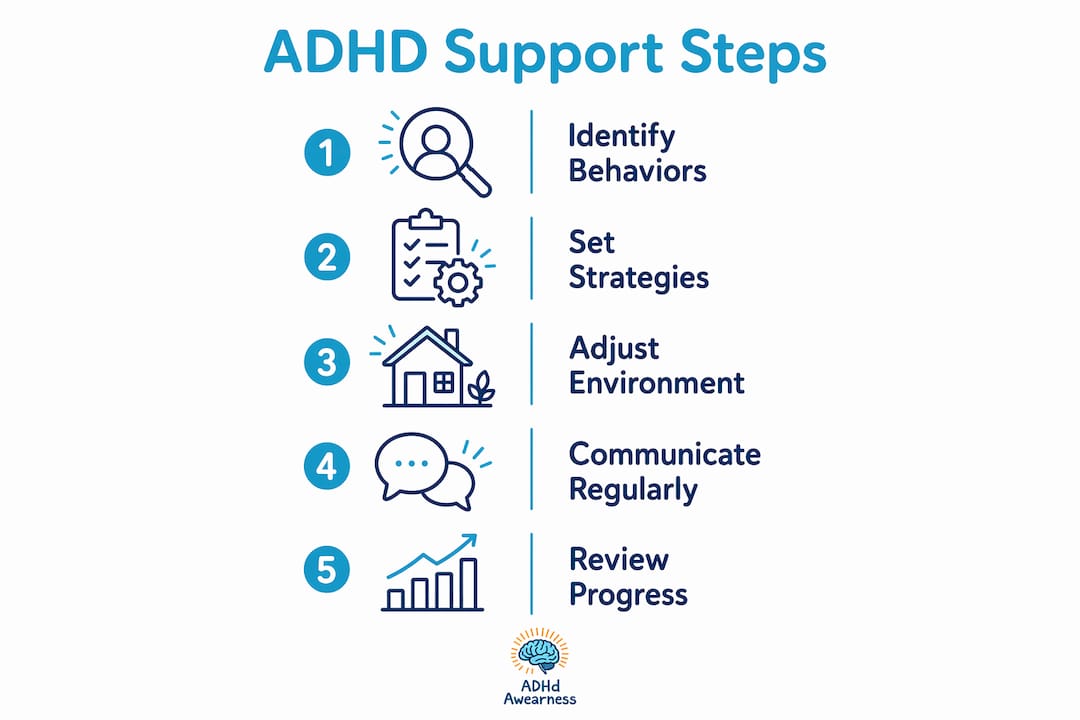
Flexible seating gives students a legal outlet for their need to move. A wobble cushion, a standing desk option, or a designated quiet corner lets a student self-regulate without disrupting the class. Seating near the teacher and away from high-traffic areas like doors and pencil sharpeners also reduces distraction.
Instruction delivery matters as much as content. Simplifying and breaking down instructions into single steps reduces the working memory load that causes students with ADHD to lose track mid-task. Pairing verbal instructions with a written version on the board gives students a reference point when they lose their place. Adding a visual, like a diagram or a checklist, creates a third channel for the information to land.
Offering choices within assignments builds engagement without lowering academic standards. Letting a student write a paragraph or record a voice memo covering the same content gives them agency. Agency increases dopamine. Dopamine improves focus.
- Place the student's desk near the teacher, away from windows and doors
- Write each step of an assignment on the board separately
- Use nonverbal cues like a tap on the desk to redirect without public correction
- Allow fidget tools that do not distract other students
- Check in quietly every 10–15 minutes during independent work
Regular nonverbal check-ins, like a thumbs-up signal or a sticky note, let you redirect an ADHD student without interrupting the class or embarrassing the child. Public correction often escalates behavior rather than stopping it.
What role does parent-teacher communication play in managing ADHD?
Consistent communication between educators and parents is one of the most effective tools in ADHD behavior management. Clear home-school communication using daily report cards outperforms generic behavioral expectations because it creates a shared language between the two environments where a child spends most of their time.
When parents know which specific behaviors were targeted that day, they can reinforce the same goals at home. A child who earned a positive report at school and hears about it again at dinner receives two rounds of meaningful feedback for the same effort. That repetition builds the behavioral habit faster than school-only feedback can.
Sharing both successes and challenges matters equally. A phone call only when things go wrong teaches parents to dread contact from the school. A brief weekly note that includes a win, even a small one, builds trust and keeps parents engaged in the process.
Pro Tip: Frame updates to parents around executive function, not character. "She had a hard time shifting from math to reading today" is more useful and less alarming than "she was defiant during transitions."
Building a team that includes the school counselor, a specialist if one is involved, and the classroom teacher creates a consistent support structure. When all adults use the same language and the same expectations, the student does not have to navigate conflicting rules across different parts of the school day.
What I've learned about ADHD behavior that most training misses
Most teacher training on ADHD focuses on what to do when behavior happens. Very little of it focuses on why the behavior happens, and that gap costs students enormously.
ADHD behaviors rooted in executive dysfunction are not choices. A student who cannot start a task is not being lazy. Their brain is genuinely struggling to initiate action without external structure. Once you understand that, you stop fighting the behavior and start building the scaffold the brain needs.
The other thing I have seen consistently is that educators burn out on behavior management when they try to fix everything at once. Picking two behaviors, tracking them clearly, and celebrating small wins is more sustainable and more effective than a long list of rules nobody can remember. The daily report card approach works precisely because it is narrow and specific.
Pairing clear expectations with a reinforcement that actually matters to the student is the part most plans skip. A sticker chart means nothing to a twelve-year-old who cares about free reading time. Ask the student what feels rewarding. Their answer will tell you more than any behavior chart template.
ADHD Awearness exists partly because this kind of practical, honest information is still too hard to find. Parents and educators deserve resources that treat them as capable adults who just need the right framework, not more jargon.
— Jason
ADHD Awearness: resources for educators and parents
ADHD Awearness brings together educational content, community connection, and products that carry a message of neurodiversity acceptance into everyday life.

The ADHD Awearness community hub offers blogs, videos, and podcasts built specifically for parents and educators who want clear, research-informed guidance without the clinical overload. Every piece of content is designed to make ADHD easier to understand and easier to talk about. The Abilities Collection features 100% USA-made apparel that sparks real conversations about neurodiversity, with a portion of every sale supporting ADHD-focused nonprofits. Wearing the message is one more way to normalize the conversation for every child in your classroom or home.
FAQ
What is ADHD classroom behavior?
ADHD classroom behavior refers to recurring patterns of inattention, hyperactivity, and impulsivity that interfere with a student's learning and social interaction. These behaviors stem from executive function deficits, not defiance or poor parenting.
What are the most effective classroom accommodations for ADHD?
Section 504 plans and IDEA IEPs provide legally protected supports including extended test time, preferential seating, and modified assignments. Daily report cards and positive reinforcement systems are among the most effective behavioral tools alongside these formal accommodations.
How is ADHD behavior different from typical childhood behavior?
Typical childhood behavior is situational and improves with age and guidance. ADHD behavior is persistent across settings, more intense than developmental norms, and tied to neurological differences in executive function and dopamine regulation.
What common mistakes do teachers make with ADHD students?
The most common mistake is treating ADHD behaviors as willful misconduct rather than executive function challenges. Public correction, vague instructions, and delayed feedback all make ADHD symptoms worse rather than better.
How can parents support ADHD classroom strategies at home?
Parents can reinforce school-based goals by reviewing daily report cards, using the same behavioral language teachers use, and celebrating specific wins at home. Consistent expectations across both environments accelerate behavioral progress significantly.