

TL;DR:
- Reliable ADHD videos are based on clinical facts, include clear sources, and feature disclaimers advising consultation with professionals. Personal stories can help reduce stigma but must be layered with research-backed context to prevent misinformation. Educators and parents should evaluate content critically and combine videos with professional guidance for effective support.
ADHD awareness video content is defined as media created to educate audiences about the characteristics, challenges, and support strategies associated with Attention-Deficit/Hyperactivity Disorder. When done well, these videos give parents, educators, and individuals a window into how ADHD actually works, not just how it looks in a 60-second clip. The problem is that quality varies wildly. Researchers use tools like the Global Quality Scale and the Video Power Index to evaluate reliability, and many popular videos fall short. Understanding what separates responsible ADHD educational videos from misleading ones is the first step toward using them effectively.
What makes ADHD awareness video content reliable and effective?
Reliable ADHD video content rests on three pillars: clinical grounding, transparent sourcing, and clear disclaimers. Without all three, even well-intentioned videos can do more harm than good.
Research shows that many popular videos are clinically incomplete or oversimplified. They may describe a handful of relatable traits without acknowledging that ADHD diagnosis requires a structured clinical assessment across multiple settings and time periods. That gap between "this sounds like me" and "I have ADHD" is where misinformation takes root.
Medical disclaimers are a critical ethical component of any responsible video. Explicit disclaimers urging viewers to consult qualified practitioners help prevent content from being mistaken for a diagnostic tool. A video without one is not automatically wrong, but its absence is a red flag worth noting.
Here is what to look for when assessing video quality:
- Creator credentials: Is the creator a licensed clinician, a researcher, or someone with lived experience? All three can be valuable, but their roles differ.
- Evidence basis: Does the video reference peer-reviewed research, clinical guidelines, or recognized ADHD organizations like CHADD or the American Academy of Pediatrics?
- Medical disclaimers: Are viewers clearly told that the content is educational, not diagnostic?
- Alternative explanations: Does the video acknowledge that anxiety, trauma, or other conditions can mimic ADHD symptoms?
- Collaboration: Does the creator work with clinicians or researchers to verify claims?
Pro Tip: Search the creator's channel or website for a "sources" page or research collaborations. Creators who document their partnerships with clinicians are consistently more trustworthy than those who rely solely on personal experience.
How do ADHD awareness videos balance personal experience with clinical accuracy?
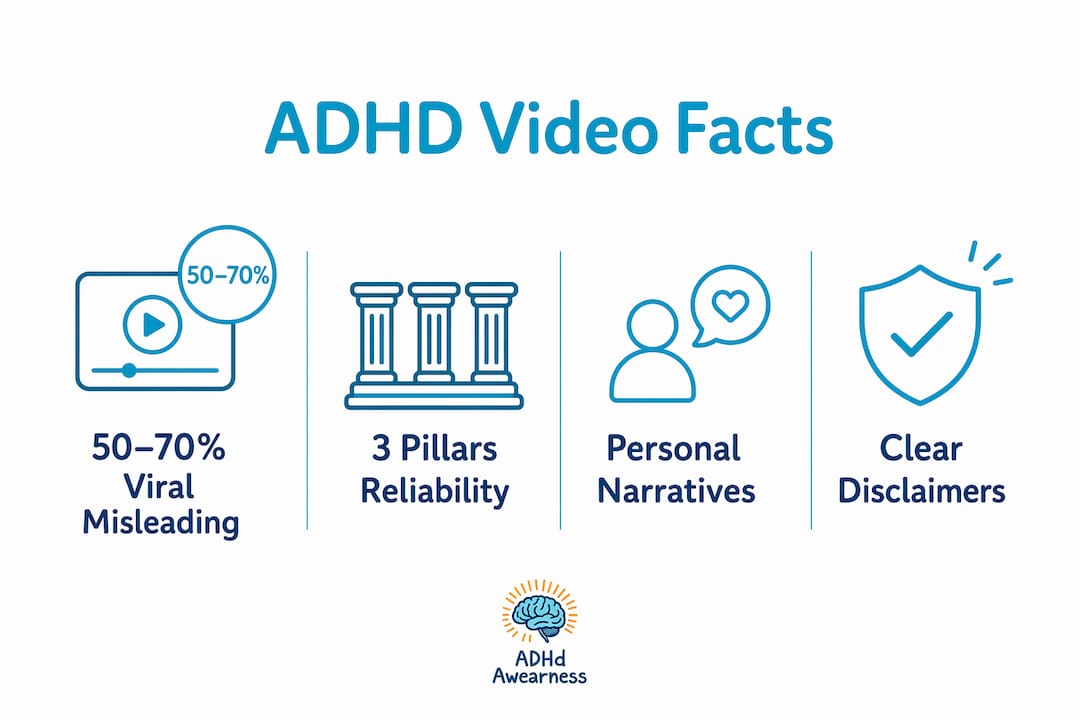
Personal narratives are one of the most powerful tools for reducing ADHD stigma. When someone shares how executive function challenges affect their daily life, it validates the experiences of viewers who have felt misunderstood for years. That emotional connection is real and valuable.

The danger appears when personal stories replace clinical context entirely. Up to 50–70% of viral mental health content is criticized for ignoring alternative explanations like anxiety or trauma that can mimic ADHD symptoms. A viewer who watches one relatable video and concludes they have ADHD has skipped the structured assessment that diagnosis actually requires.
Creators who get this balance right tend to follow a consistent pattern. They share their lived experience openly, then layer in research-backed context. Jessica McCabe, creator of the channel How to ADHD, is a widely cited example. She partners with clinical researchers and uses on-screen disclaimers to distinguish personal narrative from medical fact. That transparency is what built her audience's trust over time.
The best ADHD video explanations do four things consistently:
- Separate "this is my experience" from "this is what research shows"
- Acknowledge that ADHD presents differently across age, gender, and culture
- Encourage viewers to seek professional evaluation rather than self-diagnose
- Cite sources visibly, either on screen or in the video description
Pro Tip: When you watch an ADHD video that resonates strongly, treat it as a starting point, not a conclusion. Bring the specific questions it raises to a qualified clinician rather than using it to confirm a self-diagnosis.
What instructional strategies do effective ADHD educational videos promote?
The best ADHD educational videos do not just explain the condition. They model what support actually looks like in classrooms and at home. That practical layer is what makes them genuinely useful for parents and educators.
Structural and instructional adjustments consistently outperform punitive approaches for children with ADHD. Chunking instructions into smaller steps, using visual schedules, and building in movement breaks all increase engagement and task completion. These are not accommodations that lower expectations. They are tools that allow children with ADHD to meet expectations more consistently.
Classroom strategies modeled in quality videos
| Strategy | What it looks like | Why it works |
|---|---|---|
| Chunking instructions | Break a 5-step task into one step at a time | Reduces working memory load |
| Visual schedules | Posted daily routine with pictures or icons | Provides predictability and reduces anxiety |
| Movement breaks | Scheduled 2-minute breaks between tasks | Regulates attention and reduces restlessness |
| Positive reinforcement | Specific praise immediately after desired behavior | Builds motivation and self-awareness |
| Low-stakes check-ins | Brief one-on-one check before independent work | Catches confusion early without public pressure |
Predictable routines matter more than most people realize. Consistent routines improve task completion significantly for children with ADHD, because unpredictability taxes the executive function system that is already working harder than average. A child who knows exactly what comes next can direct more mental energy toward the actual task.
The classroom should also treat behavior as communication rather than defiance. Neurodiversity-affirming classrooms prioritize participation, regulation support, and emotional safety. When a child disrupts class, the first question is "what is this behavior telling us?" rather than "how do we stop it?" That shift in framing changes everything about how support is designed.
Effective ADHD videos model these strategies visually. Seeing a teacher use a visual schedule or a parent break down homework into timed segments makes the strategy concrete in a way that a written description rarely achieves.
How to critically evaluate and select ADHD awareness video content?
Choosing the right ADHD video content requires the same critical thinking you would apply to any health information. Popularity is not a quality signal. A video with millions of views can still be clinically incomplete or actively misleading.
- Check the creator's background. A licensed psychologist, ADHD coach, or researcher brings different expertise than a parent or content creator with lived experience. Both perspectives have value, but they serve different purposes.
- Look for source citations. Trustworthy videos reference specific research, clinical guidelines, or organizations. Vague claims like "studies show" without a named source are a warning sign.
- Read the disclaimer. A responsible video tells you clearly that its content is educational and not a substitute for professional evaluation. The absence of a disclaimer does not make a video wrong, but its presence signals ethical awareness.
- Notice what the video does not say. Simplified ADHD traits in viral videos often omit the fact that many symptoms overlap with anxiety, depression, or sleep disorders. A video that presents ADHD traits as uniquely diagnostic is oversimplifying.
- Cross-reference with recognized organizations. CHADD, the American Academy of Pediatrics, and the National Institute of Mental Health all publish evidence-based ADHD resources. Use them as a baseline when evaluating video claims.
For parents and educators, the most effective approach treats videos as one layer of a broader education strategy. A video that explains how to explain a diagnosis to a child is most useful when paired with guidance from a school counselor or clinician who knows that child specifically.
Pro Tip: Before sharing an ADHD video with a student, child, or colleague, watch it fully yourself and note any claims that feel absolute or diagnostic. Those are the moments to add context before passing the video along.
Why the responsibility of ADHD video content keeps me up at night
I have spent years watching the ADHD content space evolve, and the growth is genuinely exciting. More people are talking openly about neurodivergence than ever before. That visibility matters. But visibility without accuracy creates a different kind of problem.
The videos that go viral are rarely the most clinically careful ones. They are the ones that feel the most validating, the ones where viewers think "that is exactly me." That emotional resonance is powerful, and I understand why creators lean into it. The trouble is that short-form video content risks flattening ADHD into a handful of catchy traits that do not capture the full clinical picture.
What I have come to believe is that the most responsible creators are not the ones who know the most. They are the ones who are most honest about what they do not know. Saying "this is my experience, and your experience may differ" is not a weakness. It is the foundation of trustworthy content.
The ADHD awareness campaign space needs more creators who document their research process, name their clinical collaborators, and treat their audience as capable of handling nuance. Parents and educators deserve content that respects their intelligence and the complexity of the children they are supporting.
— Bruce
ADHD Awearness resources for informed video awareness
ADHD Awearness was built on the belief that education and advocacy belong together. The platform offers blogs, videos, and podcasts designed to give parents, educators, and individuals accurate, relatable information about ADHD without the oversimplification that plagues so much online content.
Every piece of content connects back to a larger mission: reducing stigma and building real understanding. The ADHD Awearness store carries 100% USA-made apparel that sparks conversations in schools, homes, and communities. A portion of every sale supports ADHD-focused nonprofits. Whether you are looking for educational resources or a way to wear your support visibly, ADHD Awearness offers a place to start.
FAQ
What is ADHD awareness video content?
ADHD awareness video content is media created to educate audiences about ADHD characteristics, challenges, and support strategies. Quality examples combine lived experience with clinical accuracy and include clear disclaimers that the content is educational, not diagnostic.
How can I tell if an ADHD video is reliable?
Look for creator credentials, visible source citations, medical disclaimers, and acknowledgment that ADHD symptoms overlap with other conditions. Researchers use tools like the Global Quality Scale to evaluate video reliability, and many popular videos fail these standards.
Can ADHD videos cause self-diagnosis problems?
Yes. Up to 50–70% of viral mental health content ignores alternative explanations like anxiety or trauma that mimic ADHD symptoms. Videos that present a short list of traits as diagnostic can lead viewers to incorrect conclusions without a structured clinical assessment.
What instructional strategies should ADHD videos promote for educators?
Effective ADHD educational videos model chunking instructions, using visual schedules, building in movement breaks, and applying specific positive reinforcement. These neuro-affirming strategies consistently improve task completion and engagement for children with ADHD.
How should parents use ADHD videos as part of broader support?
Parents should treat ADHD videos as one layer of education, not a standalone resource. Watch videos critically, note any absolute or diagnostic claims, and bring specific questions to a qualified clinician or school counselor who knows your child directly.