
TL;DR:
- ADHD disrupts attention, impulse control, and emotional regulation, affecting all types of relationships. Building shared structures and understanding ADHD strengths can improve communication and relationship satisfaction. External tools and systemic support foster healthier bonds and reduce household stress.
ADHD is defined as a neurodevelopmental disorder that directly disrupts attention, impulse control, and emotional regulation. These three core symptoms do not stay contained to work or school. They spill into every relationship you have, from romantic partnerships to family bonds to friendships. Understanding how ADHD and relationships interact at a neurological level is the first step toward building stronger, more honest connections. Research confirms that relationship satisfaction drops significantly in ADHD-affected couples, averaging 4.6 out of 10, yet couples where partners actively support diagnosis and treatment report the highest satisfaction scores. That gap is not fixed. It is a target.
How does ADHD affect romantic relationships?
ADHD's influence on romantic relationships begins long before conflict appears. In early stages, many people with ADHD experience hyperfocus on a new partner. This creates an intensity that feels electric and deeply connecting. The problem is that hyperfocus fades as novelty wears off, and the partner who once felt like the center of the universe suddenly feels invisible. That shift is not rejection. It is neurology.

What follows is often the most damaging pattern in ADHD partnerships: the parent-child dynamic. One partner takes on the role of organizer, reminder-giver, and rule-enforcer. The other partner feels nagged, controlled, and incompetent. Both people end up resentful. Neither person wanted this dynamic, but ADHD symptoms created the conditions for it.
Impulsivity adds another layer of friction. An ADHD partner may interrupt conversations, make financial decisions without consulting their partner, or react emotionally before thinking. These behaviors read as carelessness or disrespect to someone who does not understand the neurological basis behind them. Emotional dysregulation, a core feature of ADHD, means that small frustrations can escalate quickly and leave both partners shaken.
Here are the most common ADHD relationship challenges that couples report:
- Attentional drift during conversations, which partners interpret as indifference
- Impulsive spending or decisions that undermine shared financial goals
- Emotional outbursts followed by genuine remorse, creating a cycle of tension and repair
- Missed commitments due to time blindness, not lack of care
- Hyperfocus withdrawal, where the ADHD partner's intense attention suddenly shifts away
Pro Tip: When your partner misses a commitment, ask "What got in the way?" before assuming they did not care. That one question shifts the conversation from blame to problem-solving.
How does ADHD affect family and sibling relationships?
ADHD does not affect only the person diagnosed. It reshapes the entire family system. Siblings of individuals with ADHD are 5.5 times more likely to have ADHD themselves, and they carry a 40% higher risk for anxiety or personality disorders. That statistic means a single diagnosis in a household often signals broader mental health needs across the family.
The emotional climate of a home with ADHD is frequently charged. Meltdowns, missed routines, and reactive parenting create a kind of ambient stress that every family member absorbs. Siblings without ADHD may feel overlooked as parents direct attention toward managing the child with ADHD. Siblings with ADHD may feel blamed or compared unfavorably to each other. Both experiences damage sibling bonds over time.
The most effective shift families can make is moving from individual blame to systems thinking. Research on family-wide ADHD support shows that families function better when parents act as coaches rather than referees. That means building shared environmental supports, like visual schedules and predictable routines, rather than relying on willpower and consequences alone.
Sibling co-regulation during ADHD meltdowns is one of the most underused tools in family management. When a sibling learns to stay calm, lower their voice, and avoid escalating a meltdown, the entire household emotional temperature drops. Teaching this skill protects the sibling relationship and reduces secondary stress for every family member.
The ADHD sibling relationship impact is real and measurable. Families that address it directly, rather than treating it as a side effect of the "main" diagnosis, report stronger bonds and less chronic household tension.
What role do social skills play in ADHD relationships?
ADHD and social skills are deeply connected, and not in the way most people assume. People with ADHD do not miss social cues because they are self-absorbed. They miss them because their executive function is already running at capacity. When the brain is managing attention, filtering distractions, and regulating emotion simultaneously, there is little cognitive headroom left for reading subtle facial expressions or tone shifts. Social cue challenges in ADHD stem from this executive function exhaustion, not from a lack of interest in others.
This distinction matters enormously in relationships. If your partner believes you are ignoring their emotional signals on purpose, the conversation becomes adversarial. If they understand that your brain is genuinely overloaded, the conversation becomes collaborative.
Structured communication strategies close this gap. The following four approaches are evidence-based and practical:
- Use scheduled check-ins. A weekly 20-minute conversation with a set agenda reduces the cognitive load of spontaneous emotional discussions. Both partners know when the conversation is coming and can prepare.
- Limit topics per conversation. Covering one issue at a time prevents the ADHD brain from becoming overwhelmed and shutting down or deflecting.
- Use scripts for difficult topics. Phrases like "I feel X when Y happens" give the ADHD partner a reliable structure that reduces impulsive responses.
- Commit to one meaningful social interaction weekly. Experts recommend drilling 2–3 behavioral targets in therapy rather than attempting broad social improvement, because focused practice produces measurable gains.
Pro Tip: If you are the non-ADHD partner, try texting a conversation topic 30 minutes before you want to discuss it. This gives your partner time to shift attention and arrive at the conversation ready, not reactive.
Learning to communicate effectively with an ADHD person is a skill, not a personality trait. It can be taught, practiced, and improved.
How can couples navigate ADHD in romantic relationships?
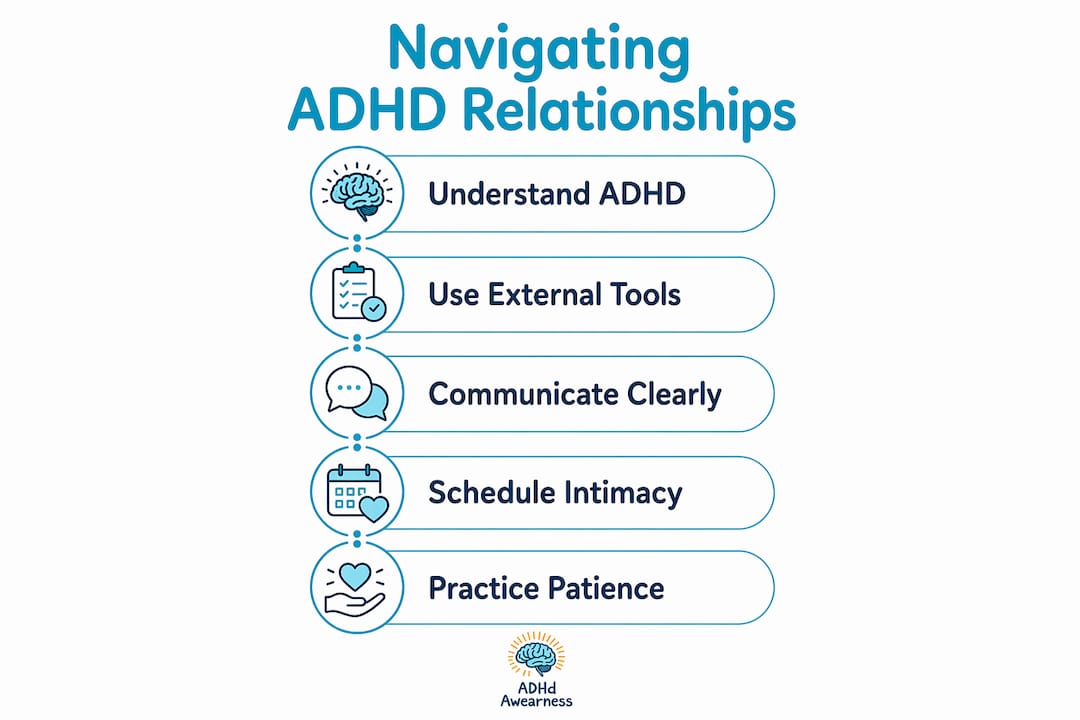
Practical strategies to navigate ADHD in romantic relationships work best when both partners understand that ADHD is a neurological condition, not a character flaw. Shifting from blame to collaborative problem-solving is the single most impactful change a couple can make. It reframes every challenge as "us versus the ADHD" rather than "me versus you."
External scaffolds are the most reliable tools in this process. Shared digital calendars, recurring phone reminders, and written household agreements remove the burden of memory from the ADHD partner and remove the burden of reminding from the non-ADHD partner. External organizational tools like these reduce interpersonal blame because the system holds the responsibility, not the person.
Scheduled intimacy is another underused strategy. Unstructured social invitations often trigger shame and avoidance in people with ADHD because they feel unprepared. Predictable rhythms for connection reduce cognitive load and build reliable pathways for closeness. A standing date night every Thursday is less romantic in theory but far more connecting in practice.
| Challenge | Blame-based response | Systems-based response |
|---|---|---|
| Missed appointment | "You never remember anything." | Shared calendar with dual reminders |
| Emotional outburst | "You are so irrational." | Agreed cool-down signal and 10-minute break |
| Interrupted conversation | "You never listen." | Scheduled talk time with no phones |
| Forgotten chore | "You are lazy." | Written task list with visual cues |
Professional support accelerates progress. Couples therapy with a therapist trained in ADHD, combined with individual coaching, produces better outcomes than either approach alone. Starting an ADHD accountability partnership outside the romantic relationship also reduces the pressure on the partner to serve as both support system and romantic companion.
- Build routines together, not rules for one person
- Celebrate small wins loudly and often
- Revisit agreements monthly, because ADHD symptoms shift with stress and life changes
- Seek therapy before the relationship reaches a crisis point
What I have learned about ADHD and relationship success
After years of reading the research and listening to real couples talk about what actually works, one pattern stands out clearly. The couples who thrive are not the ones who found a perfect system. They are the ones who stopped treating ADHD as the enemy and started treating it as shared context.
The conventional advice to "communicate better" frustrates most ADHD couples because it assumes the problem is effort. The real problem is structure. When you build the right structure, communication improves automatically. The effort was never the missing ingredient.
What I find most overlooked is the role of ADHD strengths in relationships. Hyperfocus, creativity, spontaneity, and deep empathy are all features of the ADHD brain. Partners who learn to call on those strengths during good times build a reservoir of goodwill that sustains them through the harder moments. A relationship shaped around ADHD is not a lesser relationship. It is a different one, and different does not mean worse.
Patience with gradual progress matters more than any single strategy. Progress in ADHD relationships is rarely linear. There will be weeks where every system works and weeks where everything falls apart. The measure of success is not perfection. It is whether both partners still feel like they are on the same team.
— Bruce
ADHD Awearness resources for relationship understanding
Understanding ADHD's impact on your relationships is one thing. Having a community that gets it is another.
ADHD Awearness offers educational content, including blogs, videos, and podcasts, that help individuals and families make sense of how ADHD shapes daily life and personal connections. Every piece of content is built to reduce stigma and build real understanding. The ADHD Awearness store carries 100% USA-made apparel designed to spark conversations about neurodiversity, with a portion of every sale supporting ADHD-focused nonprofits. If you want to wear your support and fund real advocacy at the same time, the ADHD Abilities Collection is a strong place to start. Building awareness starts with the people around you, and sometimes a T-shirt opens a door that a conversation could not.
FAQ
What is the most common ADHD relationship challenge?
The parent-child dynamic is the most pervasive pattern in ADHD relationships, where one partner becomes the organizer and the other feels controlled. This cycle creates resentment on both sides and is best addressed through external organizational tools rather than personal reminders.
How does ADHD affect marriage specifically?
ADHD and marriage challenges center on emotional dysregulation, missed commitments, and communication breakdowns that erode trust over time. Research shows that couples where partners actively support ADHD diagnosis and treatment report significantly higher relationship satisfaction.
Can ADHD affect siblings who do not have ADHD?
Siblings of individuals with ADHD carry a 40% higher risk for anxiety or personality disorders, even without an ADHD diagnosis themselves. The shared household stress and emotional contagion of living with ADHD affects every family member.
How do social skills training programs help ADHD relationships?
Focused social skills training that targets 2–3 specific behavioral goals produces better outcomes than broad, general advice. Scheduled interactions and communication scripts reduce cognitive load and make social connection more reliable for people with ADHD.
How can a non-ADHD partner offer support without enabling?
Supporting an ADHD partner means building shared systems, like digital calendars and written agreements, rather than serving as a personal reminder service. The goal is to make the environment do the work so the relationship stays equal and neither partner carries the full burden.