
TL;DR:
- Children with ADHD struggle with reading comprehension due to attention and executive function deficits, not decoding skills. Proper interventions like small-group instruction and text-to-speech technology improve their reading support. Accurate diagnosis and tailored strategies are essential for helping children realize their full reading potential.
ADHD-related reading difficulties are defined as reading performance problems caused primarily by attention regulation and executive function deficits, not by impairments in decoding or phonological processing. This distinction matters enormously for parents and educators, because the wrong intervention wastes time and leaves children frustrated. Up to 45% of children with ADHD also have a learning disability, compared to just 5% of children without ADHD. That gap tells you how frequently these challenges overlap, and why understanding ADHD and reading difficulties explained clearly is the first step toward real support.

How ADHD and reading difficulties affect the brain
ADHD does not impair a child's ability to decode words. What it disrupts is the mental infrastructure needed to stay engaged long enough to understand them. Think of reading comprehension as a relay race. Decoding the words is only the first leg. Holding earlier sentences in mind while processing new ones, monitoring your own understanding, and staying focused through a full page are the other legs. ADHD knocks the baton out of a child's hand mid-race, repeatedly.
Executive functioning deficits in ADHD directly impair working memory, processing speed, and organizational skills. These are the exact cognitive tools reading comprehension depends on. A child with ADHD may read a paragraph fluently, then be unable to recall what it said 30 seconds later. That is not a reading problem. That is a working memory and attention problem wearing a reading problem's clothes.
The three core ADHD symptoms each create specific reading barriers:
- Inattention causes children to lose their place, skip lines, or drift into unrelated thoughts mid-sentence, breaking the thread of meaning.
- Impulsivity pushes children to rush through text without pausing to check comprehension, leading to confident but inaccurate answers.
- Hyperactivity makes sitting still for a 30-minute reading block physically uncomfortable, which compounds the mental effort of focusing.
For a deeper look at how working memory specifically affects classroom reading, the ADHD and working memory guide from ADHD Awearness breaks down the research in plain language.
Pro Tip: Watch for the child who reads aloud accurately but cannot answer basic comprehension questions afterward. That pattern points strongly toward attention and working memory issues rather than a decoding deficit.
How does ADHD differ from dyslexia in reading challenges?
Parents and educators frequently confuse ADHD-related reading struggles with dyslexia, and the confusion is understandable. Both conditions make reading harder. But the underlying causes are different, and that difference determines which interventions actually work.
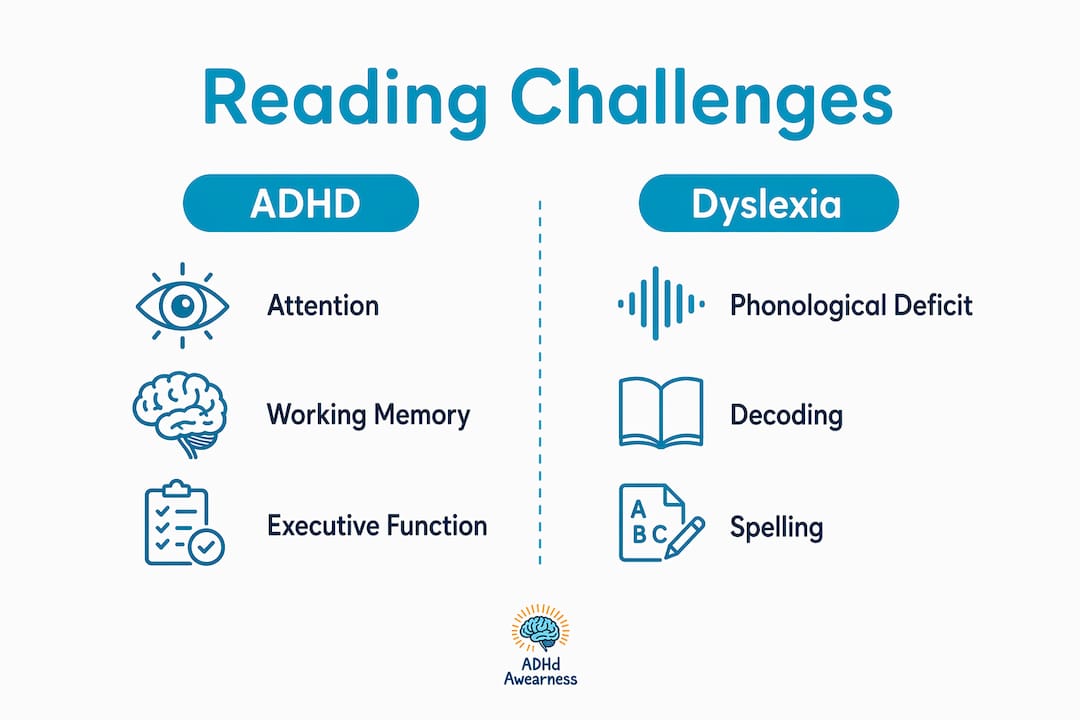
ADHD-related reading difficulty arises from attention and executive function deficits. Dyslexia arises from deficits in phonological processing and decoding, the ability to connect letters to sounds. A child with dyslexia struggles to read words accurately even in a quiet, distraction-free environment. A child with ADHD may read words accurately but lose comprehension when the text is long or the environment is noisy.
| Feature | ADHD-related reading difficulty | Dyslexia |
|---|---|---|
| Core deficit | Attention, working memory, executive function | Phonological processing, decoding |
| Word reading accuracy | Usually intact | Often impaired |
| Comprehension | Inconsistent, environment-dependent | Impaired even in ideal conditions |
| Response to TTS technology | Significant improvement | Limited improvement |
| Best intervention focus | Executive function supports, attention strategies | Phonics-based, structured literacy |
Misidentification is common because masking and variable performance complicate diagnosis. Children with ADHD often perform well on short tasks or topics they find interesting, which can make their difficulties look inconsistent or motivational rather than neurological. A proper psychoeducational evaluation cuts through that variability.
As of may 2026, 53.9% of children with specific learning disorders have neurodevelopmental or psychiatric comorbidities, with ADHD being the most frequent at 32.1%. That means many children carry both conditions simultaneously, requiring interventions that address attention regulation and decoding deficits at the same time.
What does the 2026 research say about reading interventions?
The most current evidence points clearly toward targeted, structured support rather than generic reading practice. Three findings from 2026 research stand out for parents and educators.
-
Small-group reading interventions work. A 2026 study found that small-group reading interventions significantly boost comprehension for students with ADHD, outperforming outcomes seen in other neurodevelopmental profiles after targeted training. Small groups reduce distraction, allow more frequent teacher check-ins, and create a lower-pressure environment for sustained effort.
-
Text-to-speech technology helps ADHD, not dyslexia. Research confirms that text-to-speech technology improves reading comprehension for students with ADHD by providing auditory guidance that supports sustained visual attention. The same technology does not produce the same gains for students with dyslexia. This finding matters because it shows how differently these two populations respond to the same tool.
-
Short sessions outperform long blocks. Breaking reading into 10-minute sessions with physical breaks between them produces better focus and retention than standard 30-minute reading blocks. The brain of a child with ADHD is not built for sustained low-stimulation tasks. Working with that reality, rather than against it, produces measurably better results.
Pro Tip: When using text-to-speech tools, pair them with a physical copy of the text. Encourage the child to follow along with a finger or a reading guide strip. The dual-channel input reinforces attention and retention.
| Intervention | Best suited for | Evidence strength |
|---|---|---|
| Small-group reading instruction | ADHD, mixed profiles | Strong (2026 study) |
| Text-to-speech technology | ADHD-related reading difficulty | Strong (2026 eye-tracking study) |
| Phonics-based structured literacy | Dyslexia | Strong |
| Short sessions with movement breaks | ADHD | Consistent across studies |
| Individualized executive function coaching | ADHD | Emerging |
Practical reading strategies for parents and educators
The research is clear. The harder part is translating it into Monday morning decisions at home and in the classroom. These strategies are grounded in the evidence and designed for real-world use.
Create a low-distraction reading environment. Remove competing stimuli before a reading session begins. Turn off background television, face the child away from windows, and use noise-canceling headphones if needed. The goal is to reduce the cognitive load of filtering distractions so more mental energy goes toward comprehension.
Use active reading methods. Passive reading is the enemy of comprehension for children with ADHD. Teach children to pause after each paragraph and say aloud what they just read. Encourage them to ask one question about the text before turning the page. Highlighting key sentences gives the hands something to do and anchors attention to the content.
Specific techniques that work well include:
- Chunking: Divide the reading assignment into sections of one to two paragraphs. Celebrate completion of each chunk before moving on.
- Questioning: Ask "what happened?" and "why does it matter?" after each section. This activates working memory and builds comprehension habits.
- Summarizing: Have the child write or say a one-sentence summary after each page. This forces processing rather than passive scanning.
Build predictable reading routines. Children with ADHD benefit from knowing exactly when reading happens, for how long, and what comes after. Predictability reduces the resistance that comes from task initiation difficulties, one of the most overlooked executive function challenges in ADHD.
Document patterns for professional evaluations. Documenting specific reading challenges, noting the conditions and environments where difficulty appears, gives evaluators the precise information they need to distinguish ADHD-related reading problems from learning disabilities. Note whether comprehension drops after a certain number of minutes, whether noise makes things worse, and whether reading aloud helps. These details shape the evaluation and the resulting support plan.
Pro Tip: Keep a simple reading log for two weeks before any evaluation. Record the time of day, length of session, environment, and how the child performed. Patterns in that data are more useful to a psychologist than a general description of "struggles with reading."
For educators looking for classroom-specific redirection techniques, the ADHD Awearness guide on redirecting ADHD students offers practical, low-disruption approaches that keep reading sessions on track.
What I've learned about ADHD reading struggles that most articles miss
After spending years in conversations with parents, educators, and researchers in the ADHD space, one pattern stands out clearly. The children who fall furthest behind in reading are rarely the ones with the most severe attention problems. They are the ones whose attention problems were mistaken for laziness, low motivation, or low intelligence. That misread costs years.
The research on ADHD reading challenges is advancing fast, and 2026 has brought sharper evidence than we had even two years ago. But the gap between what research shows and what happens in most classrooms remains wide. Small-group instruction and text-to-speech tools are proven. They are also underused. That is not a funding problem alone. It is an awareness problem.
Parents, you are not overreacting when something feels off about how your child reads. Trust the pattern you observe at home. Document it. Bring it to the evaluation. Educators, the child who reads fluently but fails comprehension questions is not being careless. That child may need a fundamentally different kind of support than the one currently on offer. Collaboration between home and school, grounded in accurate diagnosis, is where real progress happens.
Neurodiversity is not a deficit to be corrected. It is a different cognitive profile that requires a different approach. The goal is not to make a child with ADHD read like a neurotypical child. The goal is to build the conditions where their actual intelligence can show up on the page.
— Bruce
How ADHD Awearness supports families facing reading challenges

ADHD Awearness exists to close the gap between research and real family life. The blog, podcast, and video content cover topics like the ones in this article, written in plain language for parents and educators who need answers, not academic abstracts. Every piece of content is built around one goal: making ADHD easier to understand and easier to support.
Beyond education, ADHD Awearness offers 100% USA-made awareness apparel that sparks real conversations about neurodiversity. A portion of every sale supports ADHD-focused nonprofits. When you wear the message, you carry the conversation into spaces where it matters. Visit ADHD Awearness to explore educational resources, connect with a community that gets it, and find apparel that stands for something.
FAQ
What causes reading difficulties in children with ADHD?
ADHD-related reading difficulties stem from deficits in attention regulation, working memory, and executive function, not from impaired decoding or phonological processing. These cognitive challenges disrupt comprehension and sustained engagement with text, even when word-reading accuracy is intact.
Is ADHD the same as dyslexia?
ADHD and dyslexia are distinct conditions with different underlying causes. Dyslexia involves phonological processing deficits that impair word reading accuracy, while ADHD disrupts attention and executive function, affecting comprehension and reading stamina.
Does text-to-speech technology help children with ADHD read better?
Research confirms that text-to-speech technology improves reading comprehension for students with ADHD by supporting sustained visual attention. The same benefit does not extend to students with dyslexia, making accurate diagnosis critical before choosing assistive tools.
How long should a reading session be for a child with ADHD?
Short, high-intensity sessions of around 10 minutes with physical breaks between them produce better focus and retention than standard 30-minute reading blocks. Structuring sessions this way works with the ADHD brain rather than against it.
How can parents prepare for an ADHD reading evaluation?
Parents should document specific reading challenges over at least two weeks, noting the time of day, session length, environment, and performance patterns. That detailed record gives evaluators the precise information needed to distinguish ADHD-related reading difficulties from learning disabilities.