
TL;DR:
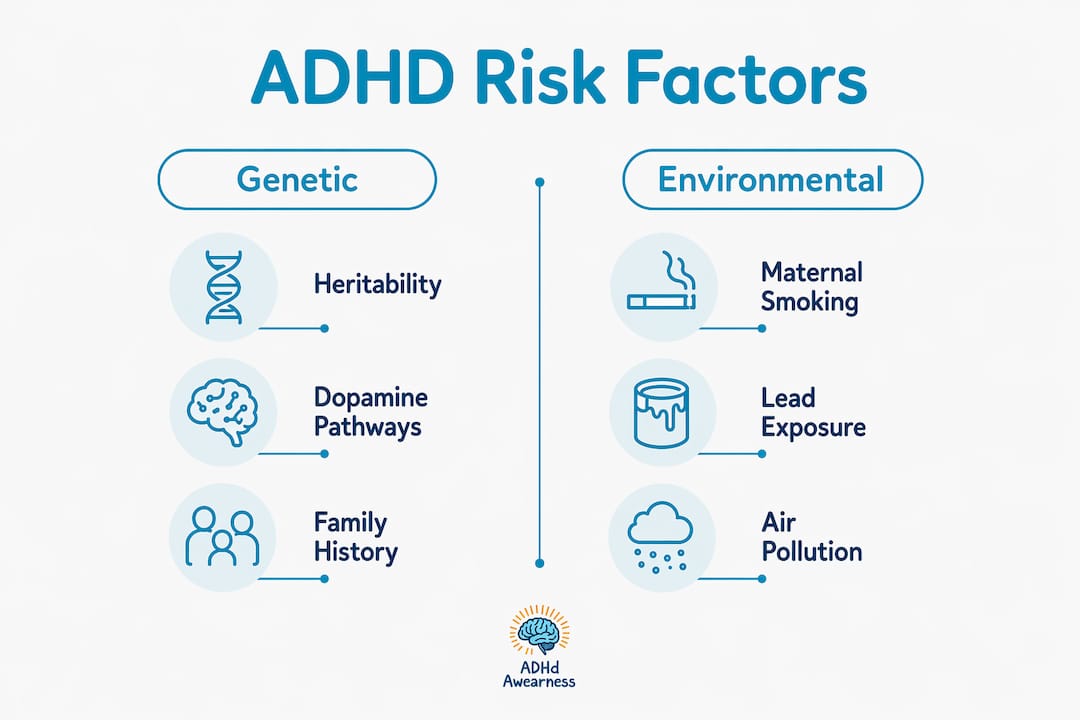
- ADHD is primarily a neurobiological condition caused by genetic and environmental factors that influence brain development. Its heritability is around 74%, involving many genes that affect dopamine and norepinephrine pathways, which regulate attention and impulse control. Environmental exposures like prenatal tobacco, lead, and air pollution increase the risk but do not cause ADHD on their own.
Attention-Deficit/Hyperactivity Disorder, or ADHD, is defined as a neurodevelopmental condition caused by a complex interaction of genetic predispositions and environmental factors that affect brain development. Understanding what causes ADHD in kids matters because it shifts the conversation away from blame and toward biology. The CDC identifies genetics as a primary risk factor alongside environmental exposures and early health conditions. Yale Medicine confirms that ADHD is a biological condition rooted in brain chemistry, not a product of poor parenting or lack of discipline. Knowing this is not just reassuring. It is the foundation for getting your child the right support.
What causes ADHD in kids? The genetic foundation
ADHD is one of the most heritable conditions in child psychiatry. Research confirms ADHD heritability at approximately 74%, meaning genetics account for roughly three quarters of the risk. That number tells you something important: if a parent or sibling has ADHD, the chances of a child developing it are meaningfully higher than in the general population.

The genetic picture is not simple, though. ADHD does not follow a single-gene pattern like some inherited diseases. Instead, it involves a polygenic architecture, meaning hundreds of genes each contribute a small effect. Think of it like a volume dial with many hands on it at once. No single gene turns ADHD on. Many genes together nudge the brain toward vulnerability.
The genes most studied in ADHD research affect dopaminergic and noradrenergic pathways. These are the brain systems that regulate dopamine and norepinephrine, two neurotransmitters central to attention, motivation, and impulse control. When the genes governing these pathways carry certain variants, the brain's signaling becomes less efficient. That inefficiency shows up as the common symptoms of ADHD: difficulty sustaining focus, acting before thinking, and struggling to start or finish tasks.
A family history of ADHD raises risk but does not guarantee a diagnosis. Genetics set the stage. What happens on that stage depends heavily on environmental factors.
Pro Tip: If ADHD runs in your family, share that history with your child's pediatrician early. It helps clinicians assess risk more accurately and can speed up the path to evaluation.
Key genetic facts parents should know:
- ADHD heritability is estimated at approximately 74%, making it one of the most heritable childhood conditions.
- Many genes contribute small effects rather than one gene causing ADHD outright.
- Dopamine and norepinephrine pathways are the primary genetic targets in ADHD research.
- A parent with ADHD significantly increases a child's risk, but many children with a family history do not develop ADHD.
- Genetics create vulnerability. Environment determines how that vulnerability expresses itself.
Which environmental exposures increase ADHD risk in children?
Genetics alone do not explain every case of ADHD in children. Environmental exposures during pregnancy and early childhood add meaningful risk on top of genetic vulnerability. Researchers now understand that risk accumulates across development, with early exposures compounding genetic predispositions over time.
The most studied environmental risk factors are ranked below by strength of evidence:
-
Prenatal tobacco exposure. Maternal smoking during pregnancy is one of the most replicated risk factors for ADHD. A meta-analysis of prospective cohort studies found that maternal smoking raises ADHD risk by approximately 1.55 times in offspring. That association holds even after researchers adjust for the mother's own ADHD history, which is a critical distinction because mothers with ADHD are more likely to smoke and more likely to pass ADHD genes to their children.
-
Lead exposure. Lead is a potent neurotoxin with a dose-dependent relationship to ADHD risk. Research shows that lead exposure at 10 µg/dL is associated with up to approximately three times the ADHD risk compared to unexposed children. Even low-level lead exposure from old paint, contaminated water, or soil affects developing brain circuits.
-
Air pollution (PM2.5). Fine particulate matter in air pollution crosses the placental barrier and affects fetal brain development. An umbrella review found that PM2.5 exposure during pregnancy is associated with an odds ratio of approximately 1.82 for ADHD. That means children born to mothers with high PM2.5 exposure have nearly double the baseline risk.
-
Environmental tobacco smoke (ETS). Secondhand smoke exposure in early childhood also matters. Research links daily ETS exposure to 1.8 times higher odds of ADHD symptoms, suggesting that the risk from tobacco does not end at birth.
-
Pregnancy and birth complications. Prematurity and low birth weight are associated with higher ADHD rates. Premature birth disrupts critical windows of brain development, particularly in the prefrontal cortex, which governs attention and self-regulation.
-
Early childhood head injuries. The CDC notes head injuries in early childhood as a recognized risk factor for ADHD diagnosis. Traumatic brain injury can disrupt the same frontal circuits that ADHD affects, making diagnosis and treatment more complex.
| Environmental Risk Factor | Approximate Risk Increase | Key Mechanism |
|---|---|---|
| Maternal smoking | ~1.55x | Nicotine disrupts fetal brain development |
| Lead exposure (10 µg/dL) | ~3x | Neurotoxic damage to dopamine pathways |
| Air pollution (PM2.5) | ~1.82x | Neurotoxic effects on fetal brain |
| Environmental tobacco smoke | ~1.8x | Ongoing neurotoxic exposure post-birth |
| Prematurity / low birth weight | Elevated | Disrupted prefrontal cortex development |
Pro Tip: You cannot change your child's genetics, but some environmental risks are modifiable. Reducing household tobacco smoke exposure and testing older homes for lead are concrete steps that support brain health.
How do brain differences explain ADHD symptoms in children?
ADHD is not a character flaw or a discipline problem. It is a brain difference, and neuroimaging research has made that clearer than ever. Yale Medicine describes ADHD as a biological condition in which dopamine signaling is inefficient, directly impairing attention and motivation. Think of the brain's communication system as a carefully tuned sound system. In ADHD, the volume on key channels is turned down, making it harder to tune in to what matters.
The brain regions most affected are part of the fronto-striatal circuit. This network connects the prefrontal cortex, which handles planning and impulse control, to deeper structures like the caudate, putamen, and nucleus accumbens. These structures regulate reward processing and motivation. When this circuit underperforms, children struggle to start tasks, stay on track, and resist impulses, not because they choose to, but because the brain's wiring makes those things genuinely harder.
Neuroimaging studies show modest structural differences in these regions in children with ADHD compared to neurotypical peers. The differences reflect brain network immaturity rather than permanent damage. Many children show a developmental lag in cortical maturation, particularly in the prefrontal areas. This is why some children appear to "grow out" of certain ADHD symptoms as the brain matures, while others carry symptoms into adulthood.
ADHD reflects a brain that is wired differently, not broken. Understanding the neurobiology behind it helps parents advocate more effectively and reduces the guilt that so many families carry.
The three types of ADHD in kids map directly onto these brain differences:
- Predominantly inattentive type. Difficulty sustaining attention, following through on tasks, and organizing work. Often missed in children who are quiet and compliant.
- Predominantly hyperactive-impulsive type. Excessive movement, difficulty waiting, and acting without thinking. More visible and often diagnosed earlier.
- Combined type. Features of both inattentive and hyperactive-impulsive presentations. The most common type diagnosed in clinical settings.
Understanding how the ADHD brain functions at a neurological level helps parents move from frustration to empathy, and from confusion to clarity.
Does parenting style cause ADHD in children?
Parenting does not cause ADHD. This is one of the most important facts for parents to internalize. The CDC is clear that family environment functions as a risk factor modifier, not a root cause. Genetics and neurobiology drive the condition. What happens at home shapes how symptoms show up day to day.
That said, the family environment genuinely matters for symptom severity. Children with ADHD who grow up in high-stress households, or who experience neglect or inconsistent caregiving, tend to show more severe symptoms. Parental mental health is also a recognized risk factor. A parent managing untreated depression, anxiety, or their own ADHD may find it harder to provide the structure and predictability that children with ADHD need most.
The distinction between cause and modifier is not just semantic. It carries real emotional weight for parents who have spent years wondering what they did wrong. The answer is: ADHD is not something you caused. It is something you can help your child manage.
Supportive parenting approaches that reduce symptom severity include:
- Consistent daily routines that reduce cognitive load and decision fatigue.
- Clear, calm, and specific instructions rather than multi-step commands.
- Positive reinforcement that targets effort and process, not just outcomes.
- Seeking your own mental health support, because a regulated parent raises a more regulated child.
- Connecting with school teams early to align home and classroom strategies, which also supports working memory in the classroom.
Risk factors do not guarantee ADHD development. Many children carry multiple risk factors and never receive a diagnosis. Many children with ADHD have no obvious environmental exposures at all. The science points to a complex interplay, not a simple cause-and-effect chain.
What I've learned about ADHD causes that most parents never hear
Parents come to me carrying guilt. They replay pregnancy decisions, parenting choices, and screen time limits, searching for the moment they caused their child's ADHD. I want to say this plainly: that search leads nowhere useful.
What the research actually shows is that ADHD emerges from a gene-environment interaction that begins before birth and unfolds across early development. No single exposure, no single gene, and no single parenting decision flips a switch. The brain differences in ADHD are real, measurable, and biological. Framing ADHD as a neurodevelopmental condition is not just scientifically accurate. It is the frame that finally lets families stop blaming themselves and start focusing on what actually helps.
The most useful shift I see in families is when they move from "why did this happen?" to "what does my child's brain need?" That question has answers. Structured environments, the right educational supports, and where appropriate, medication or therapy, all make a meaningful difference. Every child's ADHD is shaped by a unique mix of factors. That means every child's support plan should be equally specific.
Understanding the causes does not change the diagnosis. It changes how you show up for your child.
— Jason
ADHD Awearness: resources and community for parents
ADHD Awearness was built for exactly this moment. When you are deep in research, trying to understand your child's brain, and looking for a community that gets it, ADHD Awearness offers educational blogs, videos, and podcasts that translate the science into language families can actually use.

Every purchase from the ADHD Awearness store supports ADHD-focused nonprofits and funds ongoing education. The apparel is 100% USA-made and designed to spark real conversations about neurodiversity. Whether you are looking to learn more or wear your support visibly, ADHD Awearness connects awareness with action. Visit ADHD Awearness to read, watch, listen, and connect with a community that understands what your family is navigating.
FAQ
What is the main cause of ADHD in children?
ADHD results from a combination of genetic and environmental factors that affect brain development, particularly dopamine and norepinephrine signaling. Genetics account for approximately 74% of the risk, making it one of the most heritable childhood conditions.
Is ADHD genetic in children?
Yes, ADHD is strongly genetic, with heritability estimated at around 74%. A child with a parent or sibling who has ADHD carries a significantly higher risk of developing the condition.
Can environmental factors trigger ADHD in kids?
Environmental exposures such as prenatal tobacco smoke, lead, and air pollution increase ADHD risk but do not cause it in isolation. These factors interact with genetic vulnerability to influence whether and how severely ADHD develops.
Does bad parenting cause ADHD?
Parenting does not cause ADHD. The CDC confirms that family environment acts as a modifier of symptom severity, not a root cause. Supportive, structured parenting can meaningfully reduce how disruptive symptoms are in daily life.
What are the three types of ADHD in kids?
The three types are predominantly inattentive, predominantly hyperactive-impulsive, and combined type. Combined type is the most commonly diagnosed in clinical settings and involves features of both inattention and hyperactivity.